
THE HONEY FIELD GUIDE
Liquid Honey: Quality, Crystallization, Storage and Uses
FROM COMB TO POURABLE HONEY
This global guide explains how liquid honey is produced, why it crystallizes, how to read labels, how to store it and how its floral source changes color, aroma and flavor.
What is liquid honey?
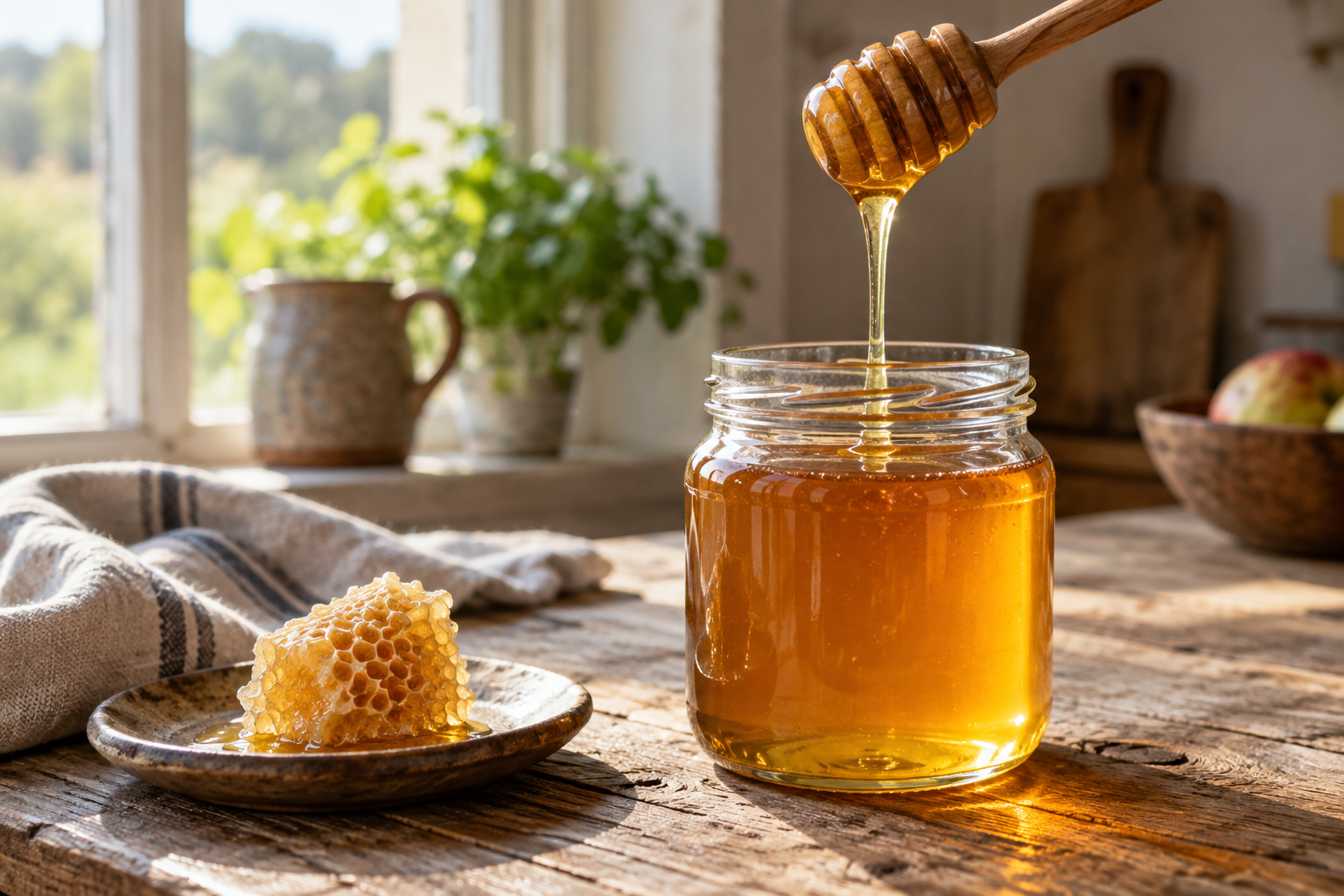
Liquid honey is extracted, drained or pressed honey that remains pourable and contains no visible crystal structure. Crystallization is natural and does not mean authentic honey has spoiled.
On this page
THE ESSENTIAL DEFINITION
Liquid is a texture—not a guarantee of processing or purity
International honey standards recognize honey as naturally fluid, viscous, partly crystallized or fully crystallized. A jar can move between those states without becoming a different food. Freshly extracted honey is usually liquid, while time and temperature may later allow glucose crystals to form.
The terms consumers see describe different questions. Liquid describes consistency. Raw is a processing claim whose exact meaning varies by market. Filtered describes removal of particles. Pasteurized indicates a heat treatment. Varietal names a predominant floral source.
Liquid honey
Fluid or viscous honey without an established crystal structure.
Crystallized honey
The same honey after glucose forms solid crystals.
Creamed honey
Honey encouraged to develop many fine crystals for a smooth spread.
EXTRACTION AND HANDLING
How honey becomes a clear, pourable product
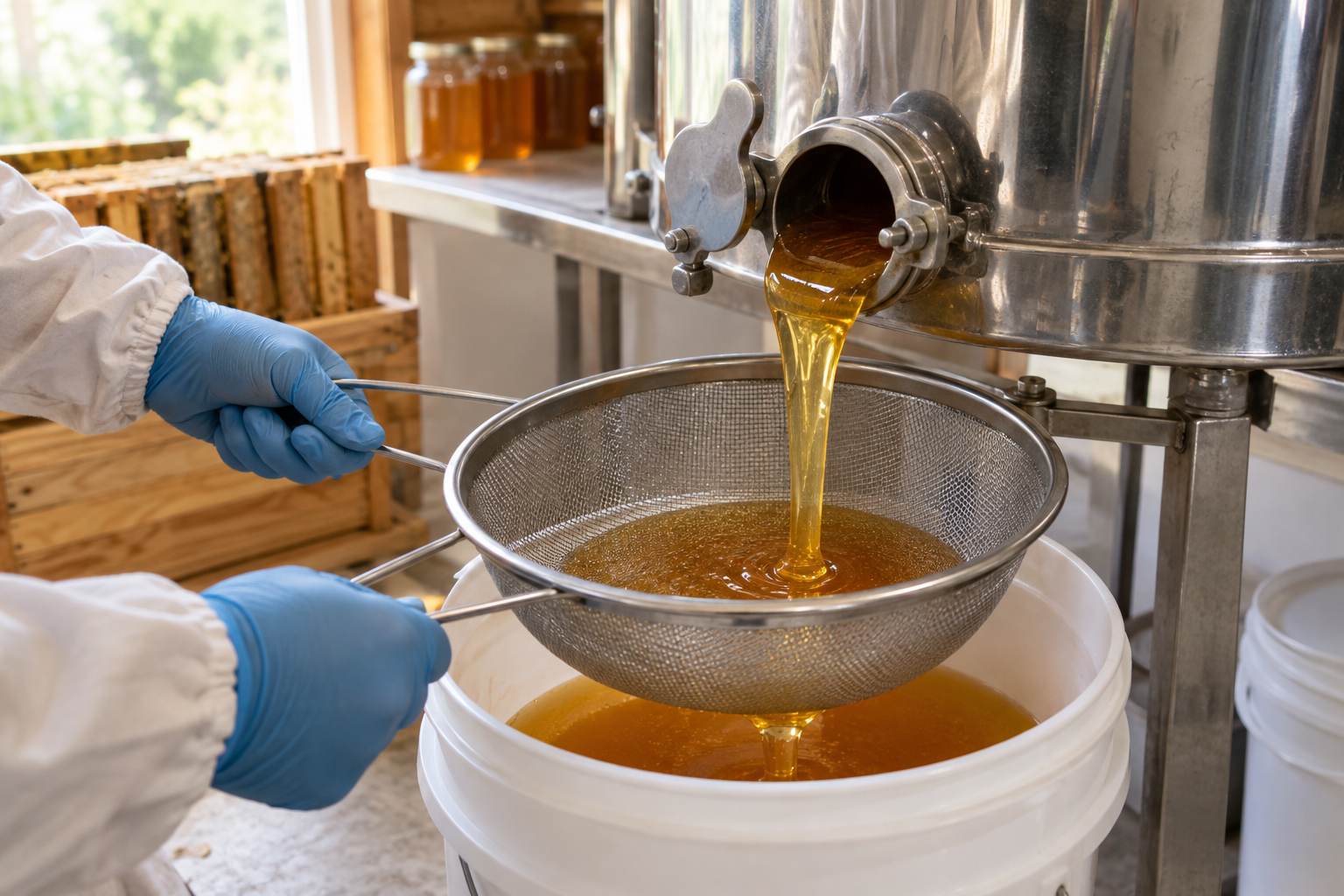
Beekeepers remove ripe honey from brood-free combs by uncapping wax seals and using centrifugal extraction, gravity draining or pressing. Fresh honey may contain harmless pieces of wax, air bubbles and other particles from handling. Straining removes larger material; finer filtration removes progressively smaller particles.
After extraction, honey may rest in a settling tank so bubbles and light wax fragments rise. Producers then bottle it under controlled conditions. Moisture management matters because honey with excessive water is more vulnerable to fermentation.
COMPARE THE LABELS
Liquid honey versus other common honey descriptions
These terms overlap. A single jar can truthfully be liquid, raw, strained and clover honey at the same time.
| Label | What it primarily describes | What it does not prove |
|---|---|---|
| Liquid honey | Current fluid or viscous consistency | Rawness, floral source, authenticity or permanent resistance to crystals |
| Raw honey | Limited processing claim, defined differently across markets | That the honey will remain liquid or contains no particles |
| Filtered honey | Removal of fine particles | That it is diluted, adulterated or nutritionally empty |
| Pasteurized honey | Heat treatment under a producer’s process | Floral origin or sweetness level |
| Creamed honey | Fine, controlled crystallization | Added cream or dairy ingredients |
| Varietal honey | Predominant botanical source | A specific processing method or texture |
A NATURAL PHYSICAL CHANGE
Why liquid honey crystallizes
Honey is a concentrated sugar solution dominated by fructose and glucose. Glucose is less soluble than fructose, so it can leave solution and organize around tiny seed particles. The jar becomes cloudy, grainy, thick or eventually solid.
- Floral source: the glucose-to-water and fructose-to-glucose balance strongly affects the rate.
- Temperature: cool storage often promotes crystal growth; very warm storage can delay it but may reduce quality over time.
- Seed crystals: pollen, wax particles or existing crystals provide nucleation points.
- Water content: composition affects both crystallization and fermentation risk.
IN THE KITCHEN
Best uses for liquid honey
Its pourability makes liquid honey especially convenient when even distribution matters.
Toast, yogurt and fruit
Use floral character as part of the dish rather than treating every honey as interchangeable.
Tea and cold beverages
Dissolve in a small amount of warm liquid before adding to iced drinks.
Glazes and marinades
Honey supports browning, so watch heat carefully.
Cakes and breads
Account for added moisture, acidity and sweetness when adapting recipes.
Vinaigrettes and sauces
Its viscosity helps balance acid, salt and spice.
Finishing boards
Pair mild honey with delicate cheeses and darker honey with stronger flavors.
BUY THE HONEY, NOT THE APPEARANCE
How to choose quality liquid honey
- Read the origin statement. Country, region, apiary or named floral source provides more context than “pure” alone.
- Check the ingredient list. A product sold simply as honey should not rely on added sweeteners.
- Look for traceability. Producer details, lot identification and harvest information improve accountability.
- Do not equate clarity with authenticity. Clear honey may be genuine; cloudy or crystallized honey may also be genuine.
- Expect natural variation. Color ranges from nearly colorless to very dark, and flavor follows botanical and geographic origin.
- Treat extravagant health claims cautiously. Honey remains a concentrated source of sugars.
PROTECT FLAVOR AND TEXTURE
Storage and gentle reliquefying
Keep liquid honey tightly closed in a clean, dry container at a stable room temperature, away from direct light and heat. Do not add water or use a wet spoon. Refrigeration generally makes honey thicker and can accelerate crystallization.
To reliquefy a crystallized jar, place the closed container in comfortably warm water and stir when practical. Warm gradually, refresh the water as needed and stop when the desired texture returns. Avoid boiling water and repeated high heat, which can flatten aroma and change color.
Discard honey that has obvious mold, uncontrolled foaming, pressure, leakage or a distinctly fermented odor. Crystals alone are normal; active fermentation is not.
CONTINUE LEARNING
Related honey guides
Compare liquid honey with raw, filtered and creamed forms.
Raw Honey
Understand what raw claims commonly mean and where definitions differ.
Filtered vs Unfiltered Honey
Compare particle removal, appearance, texture and labeling.
Creamed Honey
See how controlled crystallization creates a smooth spread.
FROM THE FIELD JOURNAL
Latest honey and beekeeping guides
Continue with current Hive To Honey articles covering honey quality, storage, bee biology and responsible sourcing.
READER QUESTIONS
Frequently asked questions
Is liquid honey the same as raw honey?
No. Liquid describes consistency; raw describes processing. Raw honey can be liquid or crystallized, and liquid honey can be raw, warmed, filtered or pasteurized.
Why did my liquid honey turn solid?
Glucose naturally formed crystals. Floral source, temperature, water content and seed particles influence how quickly this happens.
Is crystallized honey spoiled?
No. Crystallization alone is a normal physical change. Discard honey only when there are signs such as mold, uncontrolled foaming, pressure or fermentation.
Can liquid honey be filtered?
Yes. Many liquid honeys are strained or filtered to remove wax and other particles. The degree of filtration varies.
Should liquid honey be refrigerated?
Usually no. A tightly closed container at a stable room temperature is generally better for pourability. Follow any product-specific storage direction.
Can babies have liquid honey?
No honey should be given to infants under 12 months, regardless of texture or processing.
EVIDENCE BASE
Standards and research sources
- Canadian Food Inspection Agency. Canadian Grade Compendium: Volume 6 — Honey.
- Codex Alimentarius. Standard for Honey.
- Canadian Food Inspection Agency. Canadian Food Compositional Standard for Honey.
Grade names and labeling rules vary by country. Consult the current authority in the market where honey is sold.
Follow honey from comb to kitchen
Explore how floral origin, handling, temperature and time shape every jar.
Explore different forms of honey →