Honey has been valued for thousands of years as a natural sweetener and traditional food. However, as global demand for honey has increased, concerns about fake honey and honey adulteration have also grown.
Reports from food safety agencies and researchers have shown that some honey products may be diluted or altered with inexpensive syrups. These practices are known as honey adulteration.
In this guide, we will explain:
What fake honey actually means
How honey adulteration happens
Why it occurs in global markets
Common myths about fake honey tests
How scientists verify honey authenticity
Practical ways consumers can evaluate honey
This article is educational and designed to clarify the science behind honey purity and labeling.
What Is Fake Honey?
The term fake honey is commonly used to describe honey that has been altered with added sugars or syrups.
This can include:
Corn syrup
Rice syrup
Beet sugar syrup
Cane sugar syrup
When these ingredients are added to honey, the product is no longer pure honey.
Food regulations in many countries require honey to contain only substances produced by bees.
What Is Honey Adulteration?
Honey adulteration refers to any practice that alters honey’s natural composition.
This can occur in two main ways.
Direct Adulteration
Direct adulteration happens when syrups are added to honey after harvesting.
This increases volume and reduces production cost.
Indirect Adulteration
Indirect adulteration occurs when bees are fed sugar syrups during nectar flow periods.
The bees process the syrup and store it in the hive, producing a product that resembles honey but contains altered sugar composition.
Why Honey Adulteration Happens
Honey production requires:
healthy bee colonies
suitable climate
abundant floral sources
time and labor
Because natural honey production is limited, global demand sometimes exceeds supply.
This can create economic incentives for adulteration in parts of the supply chain.
However, it is important to note that many honey producers operate ethically and produce genuine honey.
Is Fake Honey Common?
Food fraud investigations have found adulteration in some international honey markets. However, the extent varies by region, regulation, and supply chain transparency.
Countries with stronger testing standards and traceability systems tend to have lower rates of adulteration.
Consumers should focus on trusted sourcing and transparency rather than assuming all commercial honey is fraudulent.
How Scientists Detect Fake Honey
Determining whether honey is authentic requires laboratory analysis.
Scientists use several methods to evaluate honey composition.
Stable Isotope Testing
Stable carbon isotope analysis can detect the presence of certain plant sugars, particularly from corn or cane syrups.
This method is commonly used in food authenticity testing.
Nuclear Magnetic Resonance (NMR)
NMR testing analyzes the chemical fingerprint of honey.
This technique can identify unusual sugar patterns that may indicate adulteration.
Pollen Analysis (Melissopalynology)
Examining pollen grains in honey helps determine botanical and geographic origin.
If pollen is absent or inconsistent with labeling claims, further testing may be needed.
Liquid Chromatography
Advanced chromatography techniques separate compounds within honey to detect abnormal sugar profiles.
These tests help identify syrup adulteration.
Common Myths About Fake Honey Tests
Many internet guides claim simple home tests can reveal fake honey. Most of these methods are unreliable.
The Water Test
A common myth says pure honey sinks in water while fake honey dissolves.
In reality, both real and adulterated honey can dissolve depending on viscosity and temperature.
The Flame Test
Some claim that pure honey burns while fake honey does not.
This test is unsafe and scientifically unreliable.
The Thumb Test
Another claim suggests pure honey stays on your thumb while fake honey spreads.
This depends largely on thickness rather than authenticity.
The Truth About Home Honey Tests
No simple home test can reliably confirm whether honey is pure.
Authenticity verification requires laboratory testing using advanced analytical equipment.
Consumers should treat viral “honey purity tests” with skepticism.
How Consumers Can Evaluate Honey
While home tests are unreliable, there are still ways to make informed purchasing decisions.
Many consumers prefer minimally processed options such as raw honey, which is typically heated less during processing.
Other products may be heated for stability, a process explained in our guide to pasteurized honey.
Check Label Transparency
Look for labels that clearly identify:
country of origin
floral source
producer information
Generic labels such as “blend of global honeys” provide less transparency.
Consider Traceable Sources
Honey from identifiable beekeepers or regional producers often provides greater traceability.
Some brands also provide batch or origin details.
Observe Natural Characteristics
Natural honey may show characteristics such as:
Uniform appearance alone does not guarantee authenticity.
Honey clarity can also depend on filtration methods. Learn more about the difference between filtered vs unfiltered honey and how it affects appearance.
Does Crystallization Mean Honey Is Real?
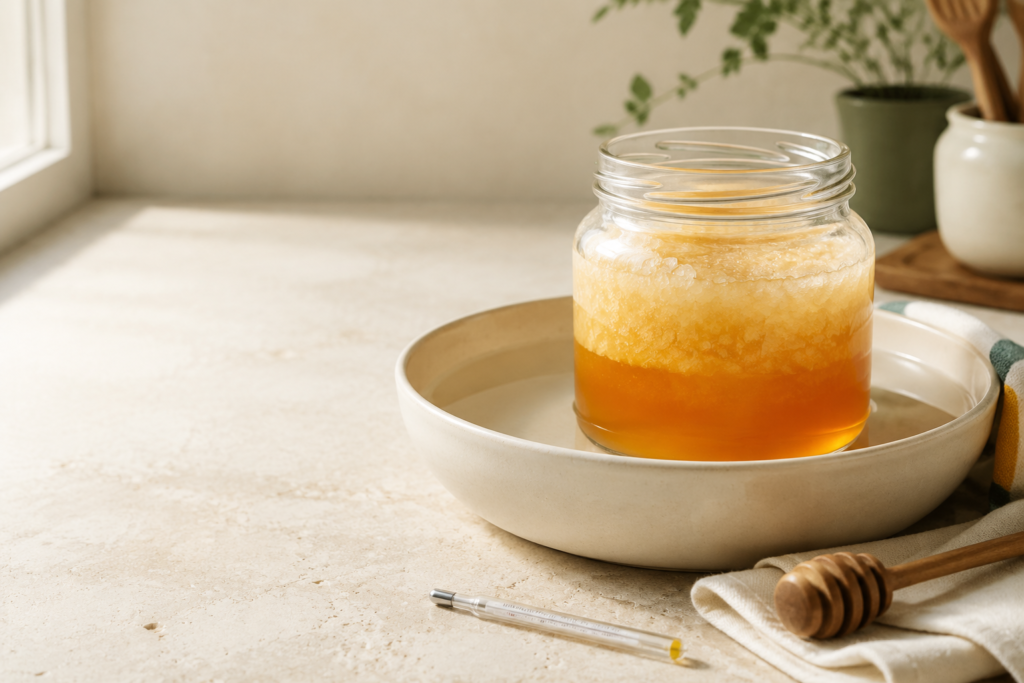
Crystallization is a natural process that occurs when glucose forms crystals within honey.
Many pure honeys crystallize over time.
However, lack of crystallization does not necessarily indicate adulteration.
Some honeys naturally remain liquid longer depending on their sugar composition.
What Food Regulations Say About Honey
Most countries define honey as a product made exclusively by bees from nectar or honeydew.
Regulations generally prohibit:
added sugars
artificial ingredients
flavor additives
Products that do not meet these standards cannot legally be labeled as honey.
Honey quality is also evaluated through grading systems that measure clarity, flavor, and moisture levels. You can learn more in our guide to honey grades explained.
Honey may also originate from nectar or from tree-based sources such as honeydew honey, which forms in forest ecosystems.
Is All Supermarket Honey Fake?
No.
While concerns about adulteration exist, many large honey brands follow regulatory standards and supply chain testing.
Food safety agencies regularly monitor honey imports and domestic production.
Consumers should avoid assuming that all commercial honey is fraudulent.
Why Honey Authenticity Matters
Authenticity protects:
consumers
ethical beekeepers
fair global markets
When adulterated honey enters the market, it can distort pricing and undermine producers who invest in genuine beekeeping practices.
Strengthening transparency helps protect both consumers and the honey industry.
Honey adulteration is a real concern in global food markets, but it is also a complex issue that requires scientific testing and regulatory oversight.
Most consumers cannot verify authenticity through simple home experiments. Instead, understanding labeling practices, sourcing transparency, and honey characteristics can help guide informed decisions.
Honey remains one of the most fascinating natural foods produced by bees, and improving awareness about honey authenticity helps support responsible production worldwide.