THE HONEY FIELD GUIDE
What Is Bee Bread? How Bees Turn Pollen Into Stored Food
POLLEN BECOMES A COLONY FOOD RESERVE
This guide explains how bee bread is made, how it differs from fresh pollen and honey, who eats it, where it appears in the comb, and what science can—and cannot—say about human use.
What is bee bread?
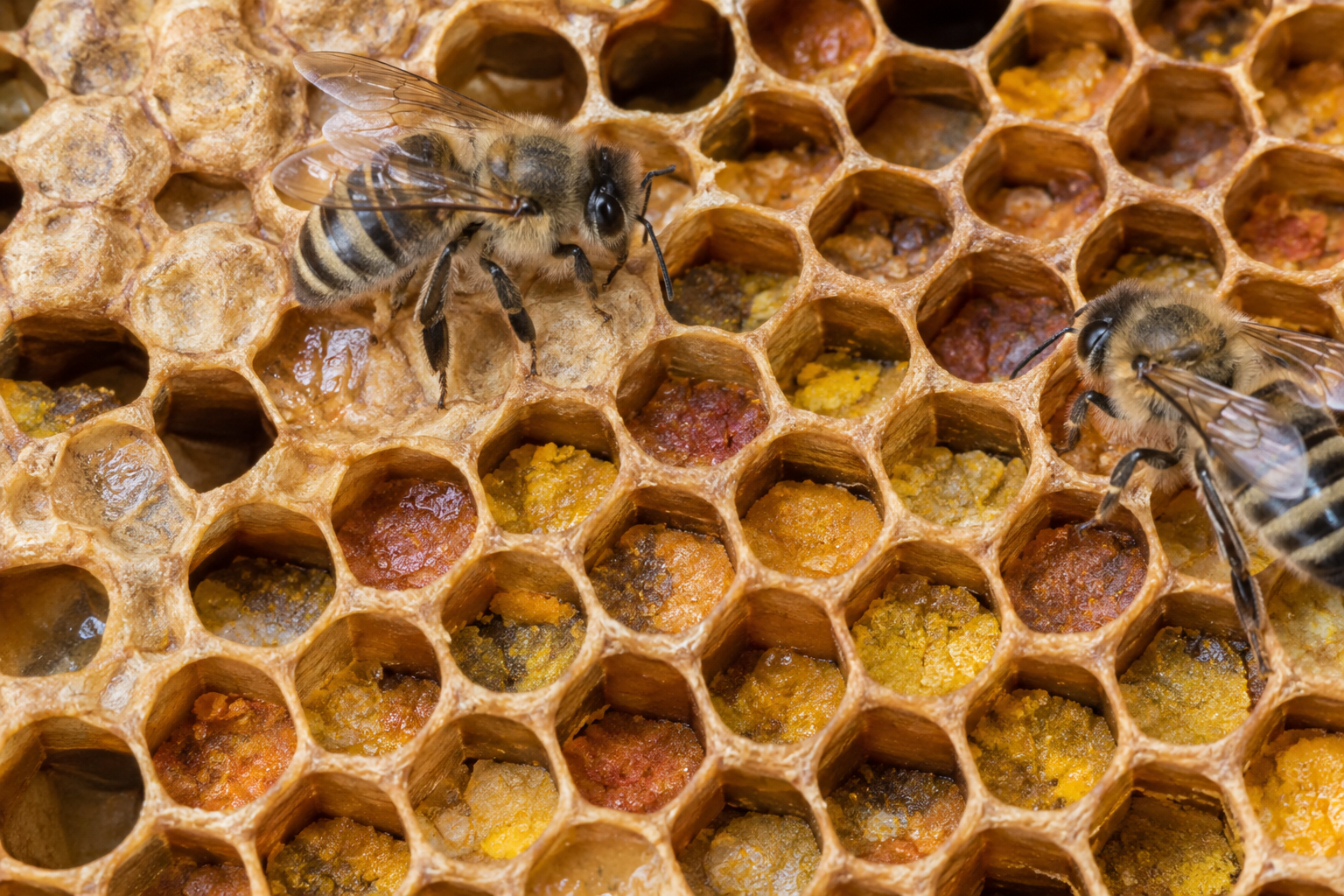
Bee bread is stored, processed pollen. Foragers bring pollen to the hive; house bees pack it into wax cells with nectar or honey and secretions. Young workers consume this nutrient-rich reserve, helping them produce glandular food for developing larvae.
ON THIS PAGE
Bee bread—from flower pollen to colony nutrition
Contents
STORED POLLEN IS PART OF A LARGER FOOD SYSTEM
What bee bread is—and what it is not
Honey bee foragers collect pollen from flower anthers, groom the grains from their bodies and compress them into loads on their hind legs. After returning to the nest, they place those loads in wax cells. Other workers pack the pollen and add liquid containing nectar or honey and secretions.
Bee bread is therefore not simply loose pollen, and it is not bread in the human sense. It is a moist, stored pollen mixture used within the colony.
Flower pollen
Plants provide the grains that contain proteins, lipids and micronutrients.
Packed in comb
Workers compress pollen with carbohydrate-rich liquid and secretions.
Colony nutrition
Young adult workers use stored pollen nutrition to support brood rearing.
FROM FORAGER LOAD TO STORED FOOD
How honey bees make bee bread
Bee bread production is a colony process rather than a single act.
| Stage | What happens | Why it matters |
|---|---|---|
| 1. Collect | Foragers gather pollen from flower anthers | Plant species determine much of the starting nutrient profile |
| 2. Transport | Pollen is groomed and packed into hind-leg corbiculae | Compact loads can be carried back to the hive |
| 3. Deposit | Foragers place loads in open wax cells | Pollen enters the colony storage system |
| 4. Pack | House bees press the material firmly into the cell | Air spaces are reduced and layers may accumulate |
| 5. Moisten | Nectar or honey and bee secretions are added | Moisture, sugars and enzymes alter the stored mixture |
| 6. Store | The material rests in the comb until consumed | Young workers can access pollen-derived nutrition near brood |
SIMILAR INGREDIENTS, DIFFERENT COLONY JOBS
Bee bread vs. bee pollen vs. honey
The terms are sometimes used interchangeably in product marketing, but they describe different materials.
| Feature | Fresh pollen load | Bee bread | Honey |
|---|---|---|---|
| Starting material | Flower pollen | Flower pollen | Nectar or honeydew |
| Bee processing | Moistened and compacted for transport | Packed with nectar or honey and secretions | Transferred, enzymatically processed and concentrated |
| Main colony role | Incoming nutrient source | Stored pollen-based food | Stored carbohydrate energy |
| Typical location | Forager hind legs or newly deposited cells | Open cells, often near brood | Open or wax-capped storage cells |
| Appearance | Compact pellets or loads | Layered yellow, orange, brown or red cell contents | Clear to opaque liquid or crystallized stores |
YOUNG WORKERS CONNECT BEE BREAD TO BROOD
Why bee bread matters to a honey bee colony
Young adult workers are the colony members most closely associated with consuming pollen and bee bread. This nutrition supports their bodies and the glands that produce food for larvae. Foragers, by contrast, rely heavily on nectar and honey for immediate flight energy.
Colony demand rises when brood rearing expands. A shortage, poor pollen diversity or low-quality forage can affect nurse bees and colony development even when carbohydrate stores appear adequate.
Growth materials
Pollen supplies amino acids needed for tissues and gland function.
Essential fats
Fatty acids and sterols support development and physiology.
Vitamins and minerals
Composition varies substantially among plant species.
Nurse-bee pathway
Larvae receive glandular food produced by adult nurses—not spoonfuls of bee bread.
COMB LOCATION REVEALS COLONY ORGANIZATION
Where bees store bee bread
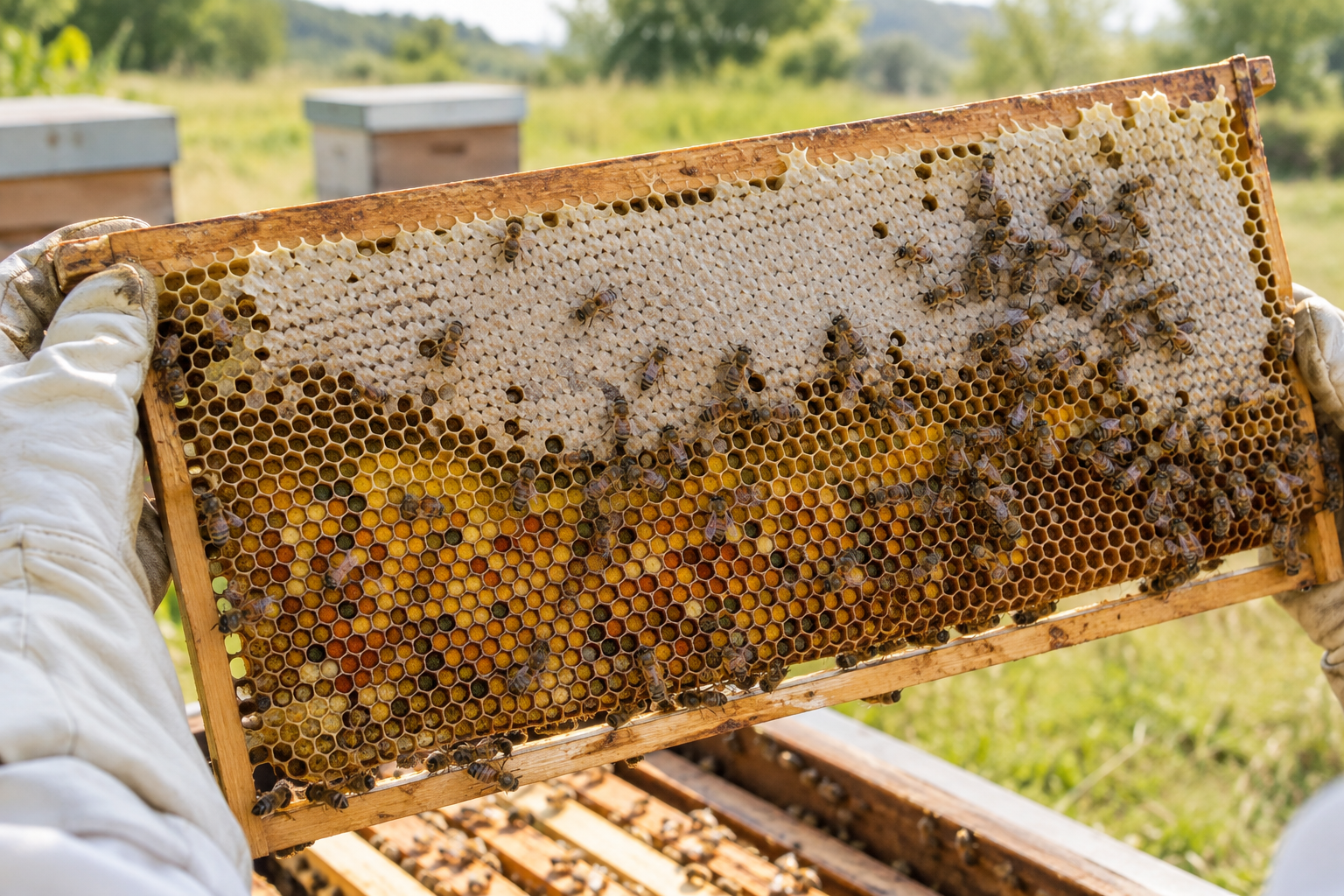
Bee bread is commonly stored in open cells close to the brood nest, where nurse bees can reach it. A frame may show brood in the center, a surrounding arc of pollen stores and honey farther outward or above. The exact pattern changes with colony strength, season, incoming forage and available space.
The material can appear granular, layered or slightly glossy. Color alone cannot identify its plant source with certainty because foragers may combine pollen from several flowers.
THE CELL IS ACTIVE, BUT “FERMENTED” NEEDS CONTEXT
Does bee bread ferment?
Microorganisms, enzymes, moisture and acids all contribute to changes after pollen is packed into cells. Researchers have documented microbial communities and chemical differences between collected pollen and stored bee bread.
However, bee bread should not automatically be described as a simple lactic-fermented product equivalent to yogurt or sauerkraut. The extent and biological importance of fermentation vary, and studies continue to examine whether preservation depends more on acidity, drying, microbial activity or their interaction.
A BEE FOOD IS NOT AUTOMATICALLY A HUMAN SUPERFOOD
Can people eat bee bread?
Bee bread is sold as a specialty food or supplement in some markets, but composition varies with floral source, geography, handling and storage. Laboratory studies describing nutrients or biological activity do not by themselves prove meaningful health benefits in people.
- Bee products can trigger allergic reactions, especially in people sensitive to pollen or other bee products.
- Quality and contamination controls vary among products and countries.
- Pregnant people, children and anyone with allergies or medical conditions should seek qualified health guidance before using supplements.
- Bee bread should not replace medical treatment or a balanced diet.
FOLLOW POLLEN FROM FLOWER TO DEVELOPING BROOD
Related bee nutrition and honey guides
Continue exploring how floral resources move through the colony.
What Do Bees Eat?
Compare nectar, pollen, honey, water and brood food.
Pollen and Its Nutritional Value
Learn what pollen contains and why quality varies.
How Do Bees Make Honey?
Follow nectar through transfer, concentration, storage and capping.
FROM THE FIELD JOURNAL
Latest bee nutrition, foraging and colony guides
Continue with current Hive To Honey articles covering pollen, nectar, honey production, colony roles and seasonal behavior.
READER QUESTIONS
Bee bread: frequently asked questions
Is bee bread the same as pollen?
No. Bee bread begins as flower pollen but is packed into comb with nectar or honey and bee secretions, then changes during storage.
Do bee larvae eat bee bread?
Larvae are mainly fed glandular food made by nurse workers. Those nurses consume pollen-derived nutrition, linking bee bread indirectly to brood development.
Why is bee bread different colors?
Pollen color varies among plant species. A cell may contain layers from different flowers, producing yellow, orange, brown, red or muted green tones.
Is bee bread fermented?
It is microbially and chemically altered during storage, but researchers caution against assuming every cell undergoes one standardized fermentation process.
Where is bee bread stored?
Workers commonly store it in open cells close to the brood nest, where nurse bees can access it.
Is bee bread proven to benefit human health?
Human evidence is limited. Nutrient analyses and laboratory findings should not be treated as proof that bee bread prevents or treats disease.
EVIDENCE BASE
Bee bread, pollen storage and honey bee nutrition sources
- U.S. Department of Agriculture, Agricultural Research Service. Honey bee health and nutrition resources.
- USDA National Agricultural Library. Apiculture and beekeeping resources.
- National Library of Medicine, PubMed. Research literature on bee bread and honey bee nutrition.
- National Library of Medicine, PubMed. Research on bee bread microorganisms and fermentation.
- Food and Agriculture Organization of the United Nations. Beekeeping and hive-product literature.
Composition and storage biology vary with bee species, flora, climate, colony condition and analytical method.
Follow bee food from field to comb
Discover how nectar, pollen, honey and bee bread support different parts of colony life.
Explore what bees eat →