
How Many Bees Are in a Hive? Inside a Honey Bee Colony
A managed Western honey bee colony may contain only several thousand adult bees during a difficult winter or early buildup, then expand to tens of thousands near its seasonal peak. A strong temperate colony is often described in the broad range of roughly 30,000–60,000 adults at peak strength—but climate, genetics, health, hive space and counting method can move the number far outside a tidy average.
This evidence-led guide explains who is in the colony, how population changes through the year, how researchers estimate it and why “one hive equals 50,000 bees” is an oversimplification.
From several thousand to tens of thousands
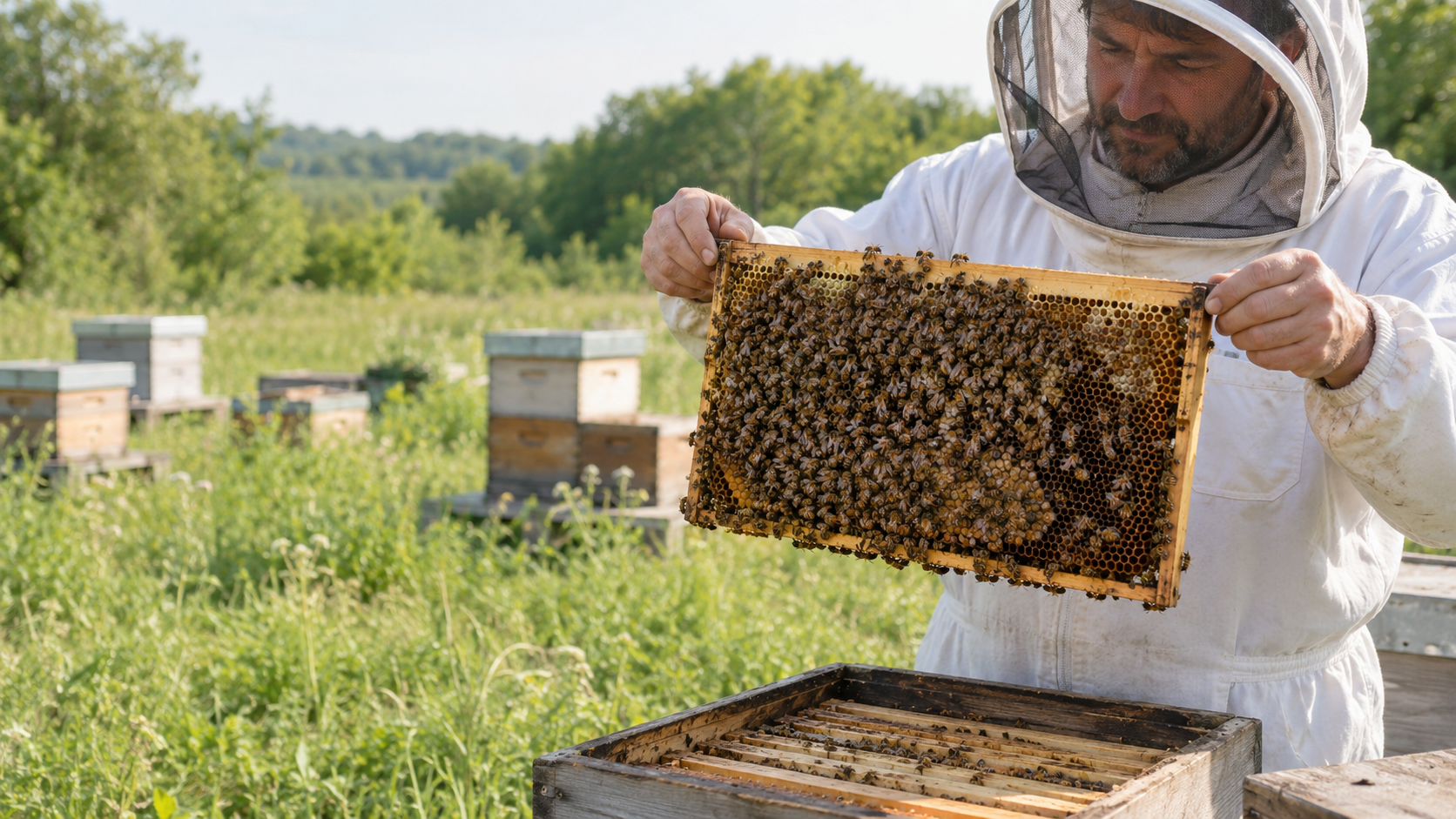
A beekeeper examines a densely occupied brood frame during spring growth. Most adult residents are workers, and the total colony population changes continuously as brood emerges and older bees die.
From one queen to a colony of tens of thousands
Contents
How many bees live in one hive?
Adult workers
For a useful answer, specify the species, season and whether the count includes adults only or brood as well.
The queen
Workers make up nearly the entire adult population. Their number rises when queen laying and brood survival exceed worker deaths, and falls when mortality outpaces emergence.
Drones
Most established colonies have one laying queen. Temporary exceptions can occur during supersedure, swarming or queen-introduction events.
Colonies may contain none in winter or hundreds to thousands during the reproductive season. Drone abundance is highly seasonal and colony-dependent.
The seasonal size of a honey bee colony
| Seasonal phase | Population pattern | What drives it |
|---|---|---|
| Late winter | Often near the annual low | Accumulated winter losses; brood rearing may only be restarting. |
| Spring buildup | Rapid expansion | Increasing brood, pollen, nectar and longer foraging windows. |
| Late spring–summer | Common peak period | A large worker force supports brood care, foraging, cooling and storage. |
| Swarming period | Sudden division is possible | A departing swarm removes the old queen and a substantial worker population. |
| Late summer–autumn | Contraction in temperate regions | Brood production and forage often decline; drone removal may begin. |
| Winter cluster | Smaller but long-lived workforce | Diutinus workers maintain heat and survive until spring replacements emerge. |
Who lives inside the hive?
A colony includes far more than the bees visible at the entrance. Adults occupy multiple boxes and spaces, while developing bees remain inside comb cells.
Workers
Female workers clean cells, feed brood, build comb, regulate temperature, guard, process food and forage. They dominate the population.
Queen
The colony usually has one reproductive queen whose egg laying supplies future workers and seasonal drones.
Drones
Male drones are reared mainly when colonies are preparing for reproduction and conditions can support them.
Brood
Eggs, larvae and pupae are living colony members but are usually reported separately from adult population.
Temporary visitors
Drifting workers or drones may enter neighboring colonies; robbers and other insects are not part of the resident colony.
The colony as a whole
Population strength depends on age structure and brood—not merely the total number visible during one inspection.
What exactly should be counted?
How colonies build population in spring
Queen laying increases
Spring growth is a pipeline. Eggs laid today do not become adult workers for about three weeks, and those workers usually spend additional time on in-hive tasks before foraging.
Nurses support brood
Day length, forage, temperature, colony condition and genetics influence the rise in egg laying.
Brood emerges
Pollen supplies protein needed for brood food, while adequate adult coverage keeps developing bees warm.
Foraging force expands
When large patches of capped brood emerge, thousands of new workers can join the colony over a relatively short period.
More workers can support more brood care and collection, creating a powerful—but resource-dependent—growth cycle.
What a large summer colony looks like
Inside the hive
At peak strength, a colony can occupy multiple brood boxes and honey supers. The adult population is spread across comb faces, spaces between frames, walls and the entrance—and some foragers are outside whenever conditions permit.
Outside the hive
Nurse bees cover brood, house bees receive nectar, workers ventilate and cool the nest, guards monitor entrances, and adults occupy food combs and newly added space.
Autumn contraction and the winter cluster
Reduced brood
In temperate regions, colony population normally contracts after the major forage season. Interpretation depends on timing, health and whether the remaining bees can cover brood and maintain the winter cluster.
Drone decline
Queen laying often decreases as days shorten and forage declines, reducing the flow of new adults.
Winter workers
Workers may expel drones and colonies may stop rearing them, conserving stores for the winter workforce.
Climate differences
Long-lived diutinus workers replace the rapid-turnover summer population and help sustain thermoregulation.
Tropical and subtropical colonies may follow rainfall and floral cycles rather than a cold winter pattern. Global guidance must not assume every colony has the same calendar.
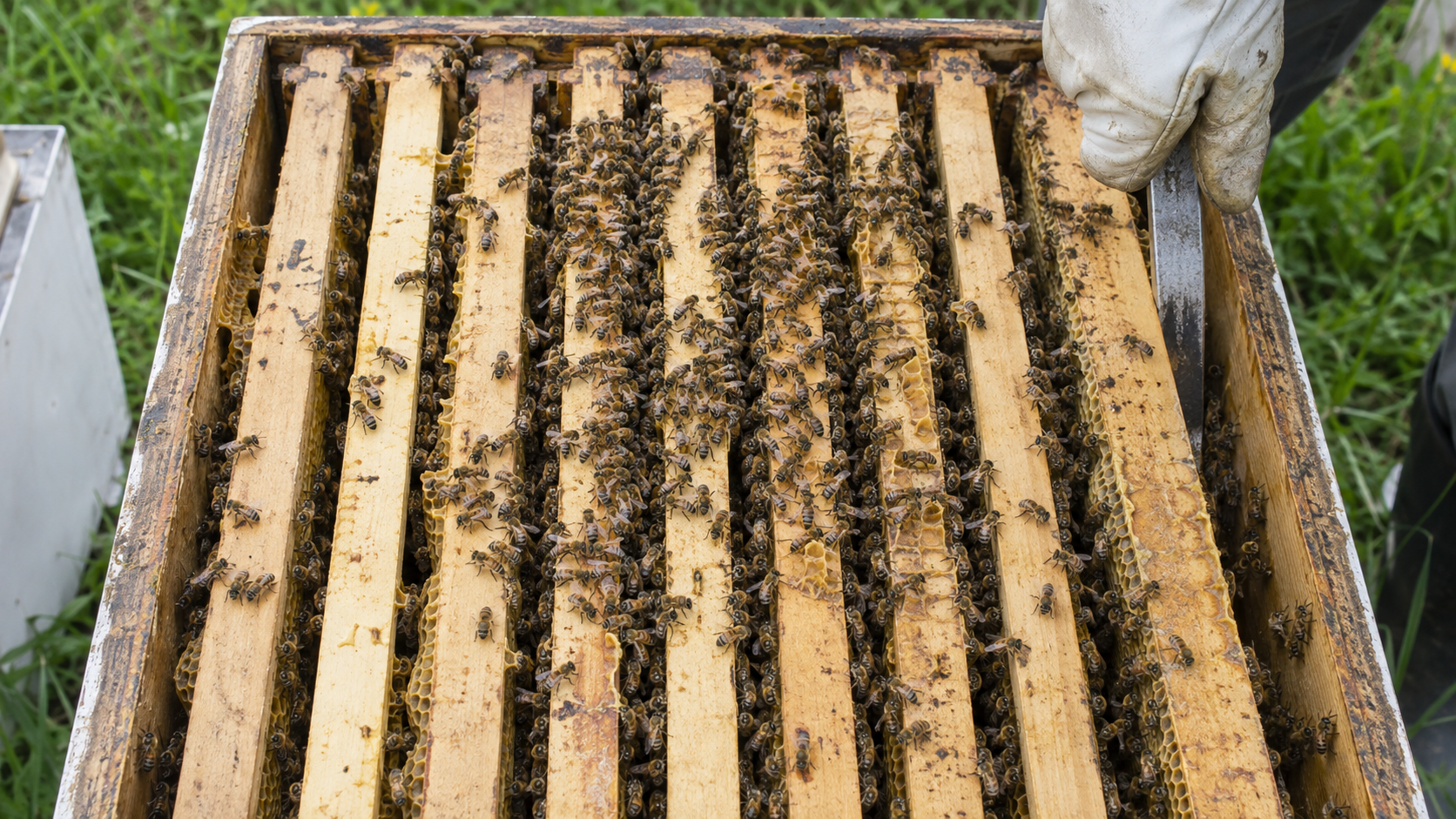
Looking down into an open hive reveals worker distribution across the frame spaces, but many bees remain hidden between combs or are outside foraging. Colony strength is therefore estimated with standardized methods.
How brood becomes adult colony population
How researchers and beekeepers estimate colony size
Colony population is usually estimated. Every method trades speed, disturbance, cost and precision.
Liebefeld method
Observers estimate the proportion of each comb side covered by adult bees and the areas of brood and stores using a standardized visual procedure.
Frames of bees
Commercial and field assessments often record substantially occupied frame spaces, but conversion to individual bees requires a defined protocol.
Photography
Images permit later review and computer-assisted counting, although overlapping bees and hidden frame areas remain difficult.
Weighing and models
Researchers may combine colony mass, brood emergence and mortality assumptions; results depend on model inputs.
Entrance counters
Electronic systems count entries and exits or detect activity. Traffic is valuable but does not equal standing population without additional modeling.
Repeat measurements
Measurements made with the same method and observer over time are usually more informative than a single impressive number.
Common colony-size myths
Simple numbers often ignore season, age structure and measurement uncertainty.
What colony size can tell a beekeeper
Trend matters: Expected spring growth or autumn contraction is more informative than an isolated estimate.
Brood pattern matters: Adult coverage without adequate healthy brood can foreshadow decline.
Food matters: Population must be matched by pollen and honey resources appropriate to the season.
Space matters: Rapid expansion can increase congestion and swarming pressure; excessive empty space can challenge a weak colony.
Parasites matter: Varroa load is a proportion as well as a count. A falling bee population can intensify the effective pressure of remaining mites.
Local benchmarks matter: Compare colonies managed in the same region, season and system using the same assessment method.
Managed hives, wild nests and different climates
A hive is a human-made container; a colony is the living social unit. Managed colonies may inhabit Langstroth, Dadant, Layens, top-bar and other hive systems, while wild colonies occupy tree cavities, walls and other spaces.
Box volume does not automatically determine bee count. Genetics, forage continuity, rainfall, temperature, disease pressure, management and nesting space all interact.
Temperate colonies commonly show strong spring buildup and winter contraction. In warmer climates, rainfall, drought and flowering cycles may shape population more than winter cold. African and Asian honey bee species also differ from the Western honey bee emphasized here.
Related honey bee biology guides
Continue with current Hive To Honey guides about colony roles, the bee life cycle, lifespan, anatomy, communication and swarming.
Bee Life Cycle
Follow the complete development of a honey bee from egg to larva, pupa and adult.
How Long Do Bees Live?
Compare the lifespans of worker bees, queens and drones across seasons and colony roles.
Honey Bee Anatomy
Explore the structures that allow honey bees to fly, feed, communicate and work as a colony.
Latest Hive To Honey Guides
Continue with the newest evidence-led guides from Hive To Honey, covering honey, bees, beekeeping and responsible storage.
Why Is My Honey Foamy? Bubbles, Wax or Fermentation Explained
THE COMPLETE HONEY FOAM GUIDE Why Is My Honey Foamy? Bubbles, Wax or Fermentation Explained Foam on honey is not automatically spoilage.
Why Does Honey Ferment? Signs, Causes and Prevention
THE COMPLETE HONEY FERMENTATION GUIDE Why Does Honey Ferment? Signs, Causes and Prevention Unintended honey fermentation usually begins when yeasts can use

Does Honey Need to Be Refrigerated? What Happens in the Fridge
THE COMPLETE COLD-STORAGE GUIDE Does Honey Need to Be Refrigerated? What Happens in the Fridge Plain honey usually belongs in a dry
Frequently asked questions about bees in a hive
How many bees are in an average hive?
There is no reliable year-round average. A colony may range from several thousand adults at a seasonal low to tens of thousands near peak strength.
Can a hive contain 60,000 bees?
Yes, a strong colony can reach that scale under favorable conditions, but 60,000 should be treated as a plausible peak estimate rather than the standard population of every hive.
How many queen bees are in a hive?
Most established honey bee colonies have one laying queen. Brief queen overlap can occur during supersedure, swarming or introduction.
How many drones live in a hive?
The number may range from none during resource-poor winter conditions to hundreds or thousands during the reproductive season.
Are eggs, larvae and pupae included in the hive population?
They are living colony members, but scientific colony-strength assessments normally report adult bees and brood areas separately.
How do beekeepers count thousands of bees?
They generally estimate adult coverage on frame surfaces, record frames of bees, analyze photographs or use standardized methods such as the Liebefeld approach.
Why does colony population fall after swarming?
The departing swarm takes the old queen and a substantial group of workers, while the original nest retains brood, stores and workers to continue with a new queen.
Does a bigger colony always produce more honey?
Large colonies can deploy more foragers, but crop yield also depends on forage, weather, timing, health, space and management. Population alone does not guarantee a harvest.
How this colony-size guide was researched
This guide separates adults from brood, colony strength from entrance traffic, and seasonal peak estimates from year-round averages. Broad ranges are used because habitat, climate and methods differ globally.
- Dainat et al. (2020), Apidologie — history and use of the standardized Liebefeld colony-strength method.
- Guzman-Novoa et al. (2025), Journal of Apicultural Research — standard methods for estimating colony-strength and flight parameters.
- Cook et al. (2024) — rigor and consistency in frames-of-bees colony auditing.
- Bozek et al. (2021), Biology Open — markerless tracking across an entire observation colony.
- Russell et al. (2013), Ecological Modelling — dynamic modeling of colony population growth and survival.
Explore how honey bee colonies grow and organize
Colony size makes more sense when you understand development, lifespan, communication and swarming. Continue through the connected Hive To Honey biology library.