
Filtered vs. Unfiltered Honey: Differences, Benefits and How to Choose
Learn what filtering actually removes, why straining is different, how heat and pasteurization fit in, and which label information matters when choosing a jar.
Filtration and heating are separate decisions
- Straining removes larger wax and hive debris.
- Fine filtration can remove much smaller particles and pollen.
- Unfiltered does not automatically mean raw.
- Clarity does not prove purity or quality.
- Crystallization is natural in either type.
- No honey is safe for infants under 12 months.
Compare honey processing clearly
Strained, filtered and unfiltered are not identical
Strained honey
Filtered honey
Unfiltered honey
Filtered vs. unfiltered honey comparison
| Feature | Filtered honey | Unfiltered honey |
|---|---|---|
| Particle removal | Ranges from ordinary straining to fine filtration | Usually retains more fine suspended material |
| Appearance | Often clearer and more uniform | May appear cloudy or contain tiny visible particles |
| Pollen | Fine filtration may remove a significant amount | May retain more, but amounts vary widely |
| Heating | May or may not be heated | May or may not be heated |
| Raw status | Can sometimes be sold as raw depending on the definition and process | Not automatically raw |
| Crystallization | May crystallize; fine filtration and heat can delay it | May crystallize sooner when seed crystals or particles remain |
| Flavor | Depends mainly on floral origin, storage and handling | Depends mainly on floral origin, storage and handling |
| Nutrition | Predominantly sugars and water | Predominantly sugars and water |
| Authenticity | Not proven or disproven by clarity | Not proven by cloudiness or particles |
| Infant safety | Never for infants under 12 months | Never for infants under 12 months |
Bottom line: neither choice wins automatically. Select based on traceability, truthful processing information, flavor, texture and intended use.
Where filtration fits in honey processing
Honey handling is a sequence, not a two-category switch. Producers may use different combinations depending on floral source, equipment, climate, market and regulations.
1. Harvest
2. Uncap and extract
3. Settle or strain
4. Filter if desired
5. Warm if needed
6. Pack and trace
Pollen, particles and provenance
Honey can naturally contain pollen, tiny wax particles, air bubbles and other suspended material. Fine filtration can reduce pollen, while coarse straining generally targets larger debris.
Skip viral water, flame, thumb and crystallization “purity tests.” They cannot reliably authenticate honey.
Does filtration change nutrition or benefits?
The major nutrients remain similar
Minor components can differ
Health claims need direct evidence
Honey evidence is not raw-only evidence
Choose unfiltered honey for its producer story, flavor, texture or preferred processing style—not because a vague label guarantees a medical benefit.
Filtration, heating and crystallization
Why honey crystallizes
Honey is a supersaturated sugar solution. Glucose can form crystals, with the rate affected by floral source, glucose-to-fructose balance, water content, temperature and seed particles.
Unfiltered honey may crystallize readily when small particles provide nucleation sites. Filtered honey can crystallize too.
What crystallization does not prove
- It does not prove that honey is raw.
- It does not prove that honey is authentic.
- It does not mean honey is spoiled.
- Remaining liquid does not prove heavy processing.
- Texture can differ within the same floral harvest.
Filtered and unfiltered honey safety
Never give honey to infants
Heat is not a guarantee
Use clean, intact products
Food honey is not medical honey
This is general food education, not individualized medical advice. People with allergies or conditions affected by carbohydrate intake should follow qualified guidance.
How to choose between filtered and unfiltered honey
Which should you buy?
Choose filtered honey when you prefer clarity, smoothness, visual consistency and easy pouring. Choose unfiltered honey when you value a less refined appearance, texture and a producer’s minimal-processing approach. Neither choice overrides authenticity, origin or food-safety considerations.
Filtered honey terminology around the world
There is no single consumer vocabulary used identically everywhere. Always distinguish ordinary clarification from legally defined fine filtration.
Codex Alimentarius
Canada
United States
United Kingdom
European markets
Global reader rule
Filtered vs. unfiltered honey FAQs
Is unfiltered honey the same as raw honey?
No. Unfiltered describes particle removal; raw describes a broader processing claim that commonly includes limits on heating. A jar may be unfiltered but warmed.
Is filtered honey pasteurized?
Not necessarily. Filtration and heating are separate operations. Read the producer’s process information instead of assuming one from the other.
Which is healthier?
Both are predominantly sugars and water. Fine filtration can reduce pollen and suspended particles, but current evidence does not support declaring every unfiltered honey clinically superior.
Does unfiltered honey contain bee parts?
Properly handled honey is commonly strained to remove larger debris. “Unfiltered” generally refers to retaining finer suspended material, not skipping responsible processing.
Why is unfiltered honey cloudy?
Fine crystals, pollen, wax particles or air bubbles can affect clarity. Appearance varies and is not a purity test.
Does filtered honey crystallize?
Yes. Fine filtration and heating may delay crystallization, but floral source, sugar balance, water and temperature remain important.
Does filtering remove all pollen?
Not always. The result depends on filter fineness and processing. Legally defined filtered honey in some markets involves significant pollen removal.
Can either type be given to a baby?
No honey in any form should be given to an infant under 12 months.
Can I test purity at home?
No popular household test can reliably prove authenticity. Use traceability, compliant labeling and validated laboratory or supply-chain controls.
Which tastes better?
Flavor is subjective and usually influenced more by botanical origin, geography, age and storage than the filtered/unfiltered label alone.
Latest honey processing and quality guides
Explore new comparisons, authenticity reporting, storage guidance and practical buying advice.
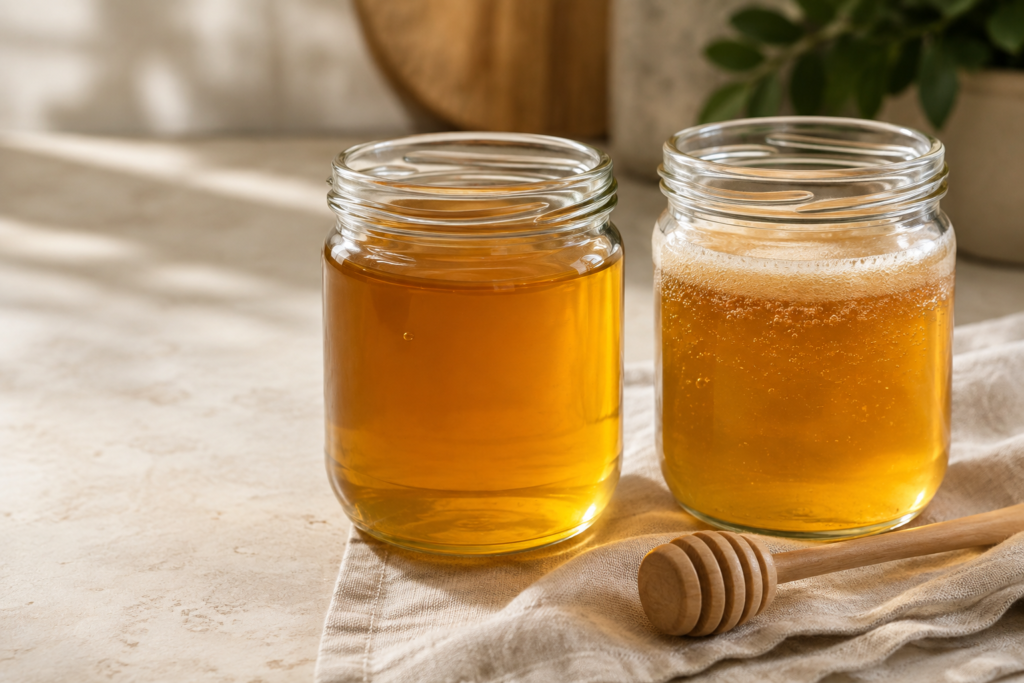
Why Is My Honey Foamy? Bubbles, Wax or Fermentation Explained
THE COMPLETE HONEY FOAM GUIDE Why Is My Honey Foamy? Bubbles, Wax or Fermentation Explained Foam on honey is not automatically spoilage.
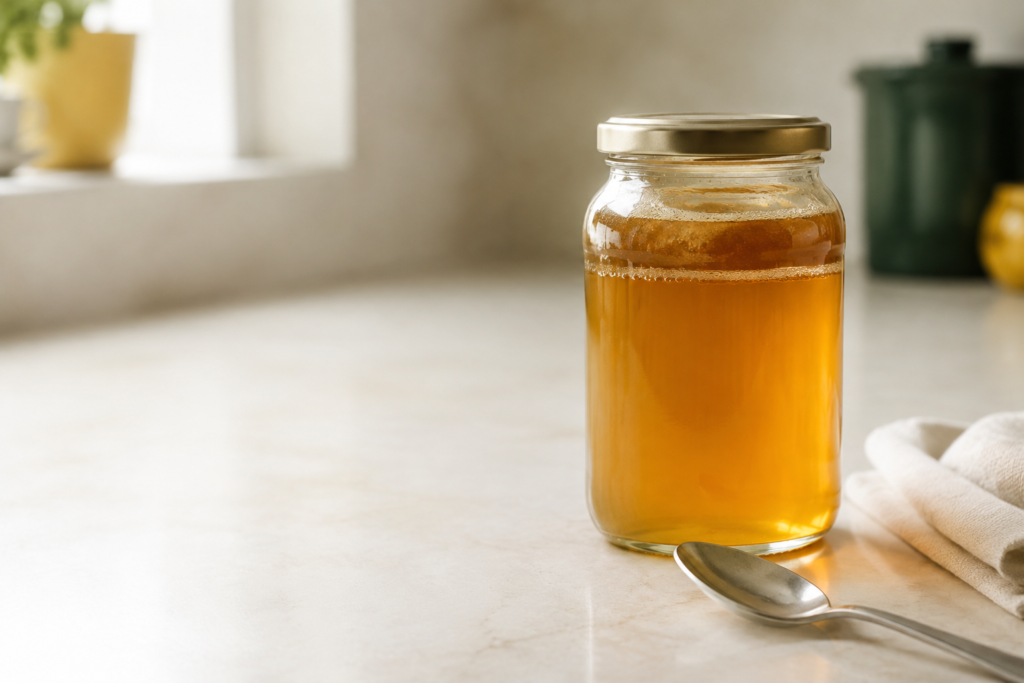
Why Does Honey Ferment? Signs, Causes and Prevention
THE COMPLETE HONEY FERMENTATION GUIDE Why Does Honey Ferment? Signs, Causes and Prevention Unintended honey fermentation usually begins when yeasts can use
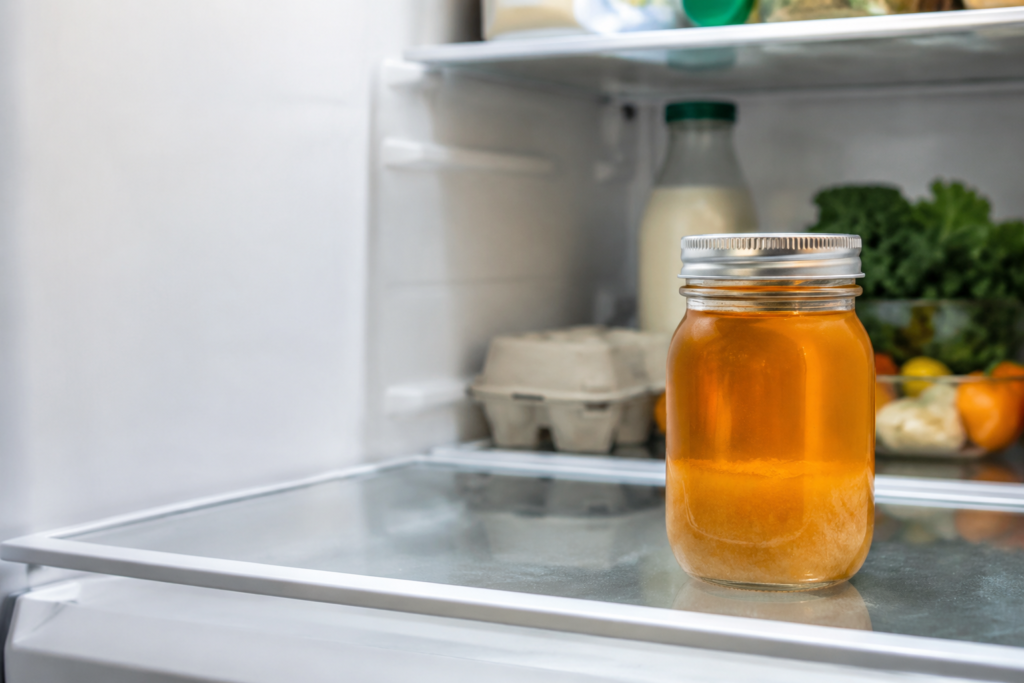
Does Honey Need to Be Refrigerated? What Happens in the Fridge
THE COMPLETE COLD-STORAGE GUIDE Does Honey Need to Be Refrigerated? What Happens in the Fridge Plain honey usually belongs in a dry
How this comparison was researched
This guide prioritizes food regulators, public-health agencies and international standards. Terminology is presented with jurisdictional context because everyday and legal meanings can differ.
- Canadian Food Inspection Agency: honey labeling requirements
- Health Canada: infant botulism and honey safety
- Public Health Agency of Canada: causes of botulism
- FAO/WHO Codex Alimentarius
- National Honey Board: honey terminology FAQ
- USDA: extracted honey grade standards
- UK Honey Regulations: filtered honey definition
- European Commission: honey authenticity
- UK Food Standards Agency: Honey Risk Profile
- Food Standards Australia New Zealand: Food Standards Code
Choose transparency over buzzwords
Filtered and unfiltered honey can both be excellent. The strongest signals are a clear origin, a responsible producer, truthful process information and a flavor you enjoy.