
Beekeeping Glossary: Essential Terms from Apiary to Winter Cluster
Understand the vocabulary used by beekeepers, researchers and honey producers. This global A–Z glossary defines colony biology, hive parts, management, health, forage, pollination and honey-harvest terms in clear language, while noting where regional usage differs.
Clear definitions with context—not instructions without explanation
- Built for beginners, experienced readers, journalists and honey buyers.
- Covers honey bee biology, hive equipment, management, pests, diseases, swarming, forage and honey production.
- Uses internationally recognizable terms and explains common North American and British differences.
- Separates a bee colony from the physical hive that houses it.
- Distinguishes brood, food stores and honey-production areas inside a managed hive.
- Links terminology to deeper Hive To Honey guides for continued learning.
Find a beekeeping term quickly
Six concepts that unlock the rest of the glossary
Apiary or bee yard
Colony
Hive
Apiaries, bees and brood
- Africanized honey bee
- A population derived partly from African honey bee lineages and established in parts of the Americas. Defensive behavior varies; identification should not be based on appearance alone.
- Apiary
- A location containing one or more managed bee colonies; also called a bee yard.
- Apiculture
- The management and study of bees—most commonly honey bees—and their colonies.
- Apiculturist
- A person who studies or practices apiculture; often used interchangeably with beekeeper.
- Apis
- The honey bee genus, which includes the western honey bee, Apis mellifera, and several Asian honey bee species.
- Bait hive
- An empty hive or cavity prepared to attract a passing swarm. Also called a swarm trap.
- Bee bread
- Pollen stored in comb and mixed with nectar or honey and bee secretions; an important colony food.
- Bee brush
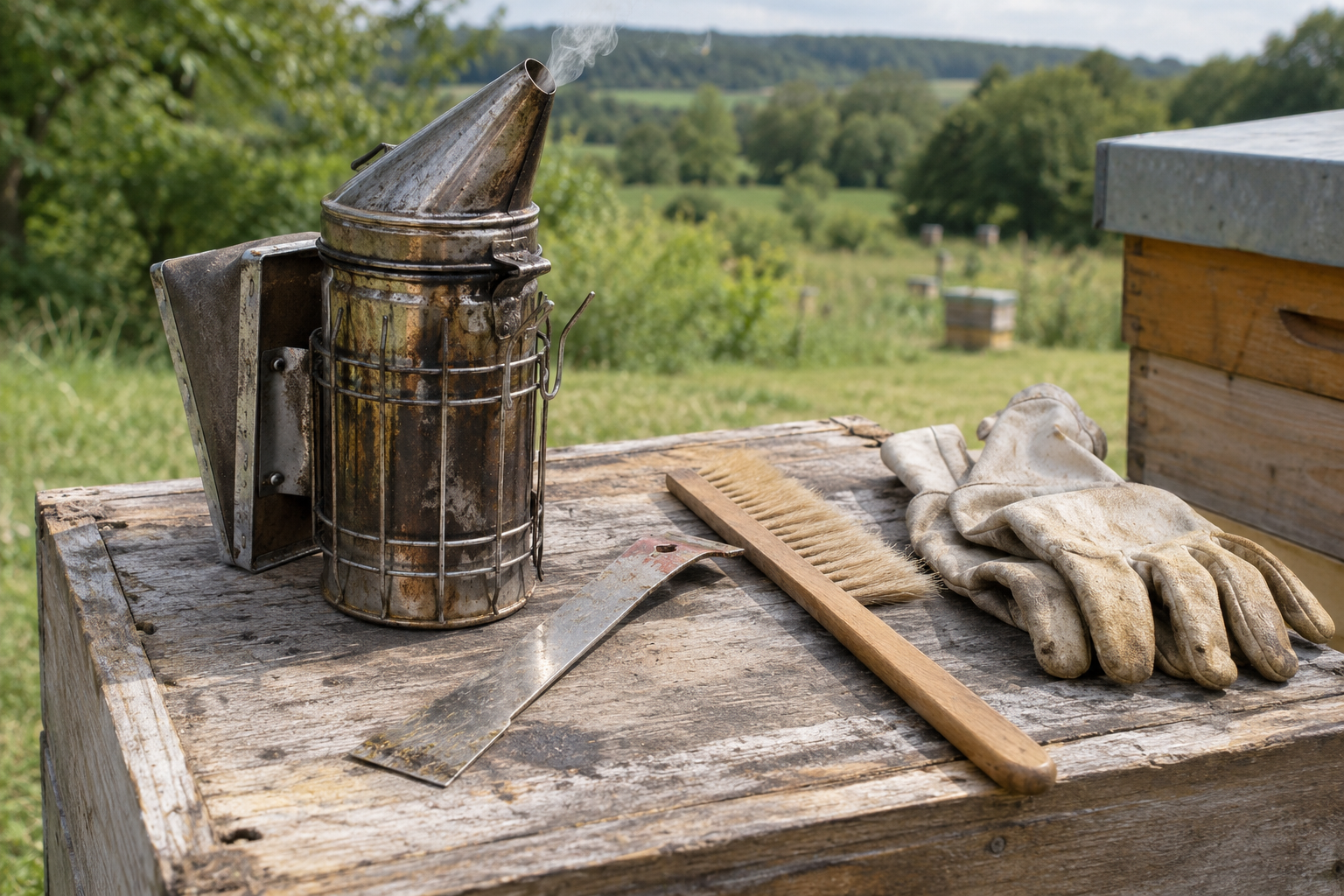
- A soft-bristled tool used to move bees gently from comb or equipment.
- Bee escape
- A one-way device that allows bees to leave a honey super but makes their return difficult.
- Bee space
- The passage width bees typically leave open for movement; modern movable-frame hives rely on this principle.
- Bee veil
- Protective mesh worn over the head and face during colony work.
- Bee yard
- Another term for apiary.
- Beekeeper
- A person who manages bee colonies. Also called an apiarist.
- Beeswax
- Wax secreted by worker honey bees and shaped into comb.
- Brood
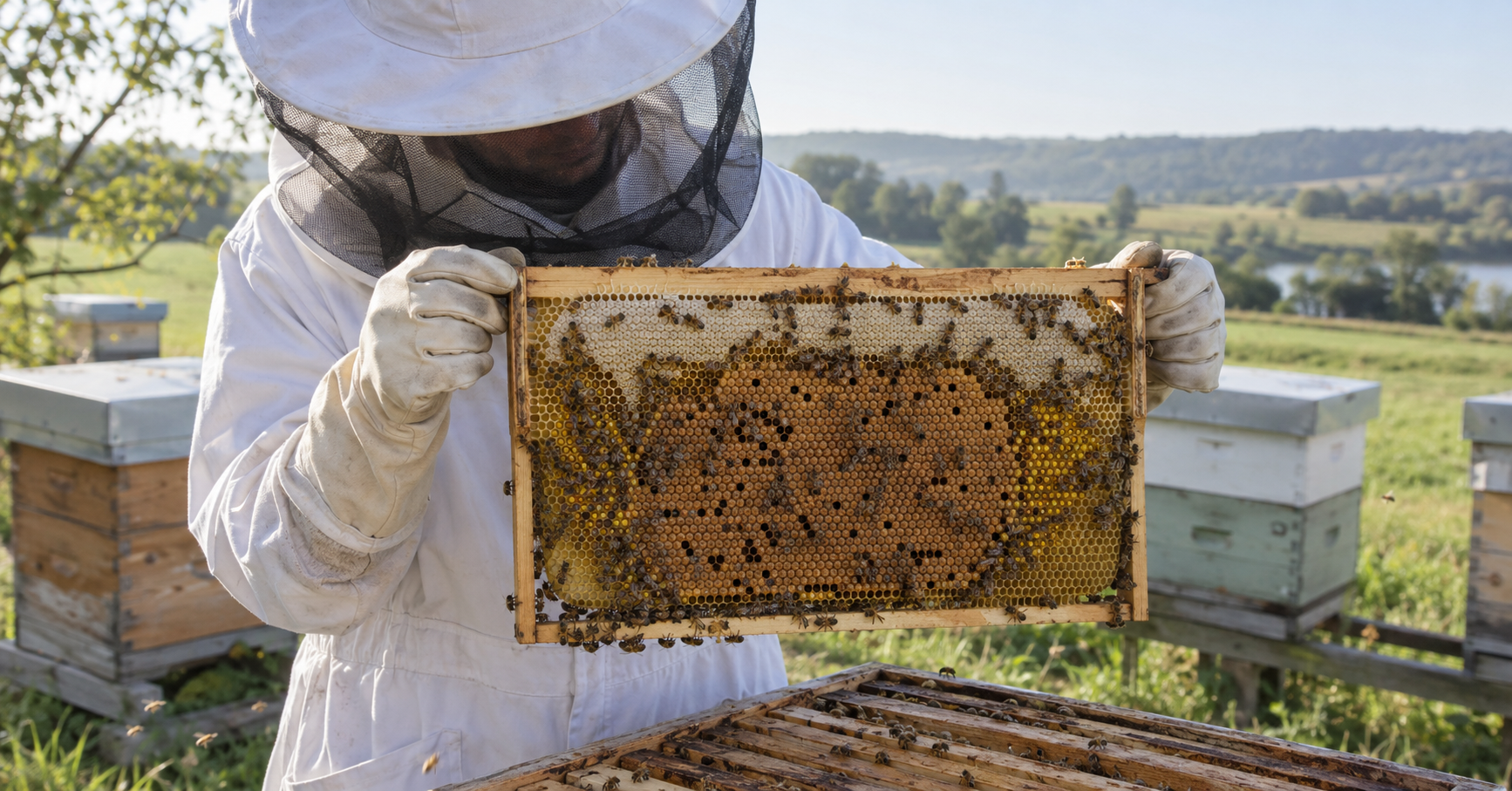
- Immature bees—eggs, larvae and pupae—developing in cells.
- Brood box
- A hive body used primarily for the queen’s egg laying and brood rearing.
- Brood nest
- The central colony area containing brood, nurse bees and nearby pollen and honey stores.
- Burr comb
- Comb built where the beekeeper did not intend it, often across gaps larger than normal bee space.
Cells, castes and colony development
- Capped brood
- Pupal-stage brood sealed beneath porous wax cappings until adult emergence.
- Capped honey
- Ripe honey sealed in cells with wax cappings. Capping extent is one clue—not the only test—of harvest readiness.
- Cell
- One wax compartment in comb, used to rear brood or store honey and pollen.
- Cell cup
- A small downward-facing wax cup that may remain empty or be developed into a queen cell.
- Cluster
- A dense grouping of adult bees, especially the winter cluster formed to conserve heat.
- Colony
- The complete living honey bee society occupying a nest or hive.
- Colony collapse disorder
- A specific syndrome involving the sudden loss of most adult workers while brood, food and the queen may remain. It is not a synonym for every colony loss.
- Comb
- A double-sided sheet of wax cells built by bees.
- Comb honey
- Honey sold within edible beeswax comb rather than removed from its cells.
- Cross-comb
- Comb built across frames or in a direction that prevents normal movable-frame inspection.
- Dearth
- A period when little nectar or pollen is available to foraging bees.
- Drone
- A male honey bee. Drones develop from unfertilized eggs and primarily contribute through mating.
- Drone brood
- Developing male bees, typically raised in somewhat larger cells with more domed cappings.
- Dysentery
- Visible fecal soiling associated with prolonged confinement or digestive stress; it is a sign, not a single disease diagnosis.
Eggs, equipment and forage
- Entrance reducer
- A device that narrows a hive entrance to alter access, ventilation or defendable opening size.
- Extracted honey
- Honey removed from comb, commonly by centrifugal extraction, draining or pressing.
- Extractor
- A machine that uses centrifugal force to remove honey from uncapped comb while leaving much of the comb intact.
- Feeder
- A device used to provide supplemental sugar syrup or another feed when justified by colony needs and local practice.
- Festooning
- Chains or curtains of bees hanging from one another, commonly observed during comb building.
- Forage
- Flowers or other resources from which bees gather nectar, pollen, resins or water.
- Forager
- A worker bee that leaves the colony to collect resources.
- Foundation
- A manufactured sheet or guide placed in a frame to influence where and how bees build comb.
- Frame
- A removable wooden or plastic structure supporting comb inside many managed hives.
- Frass
- Waste material produced by insects; its presence can help identify some hive pests.
Guarding, hive parts and honey handling
- Guard bee
- A worker stationed near the entrance that assesses incoming bees and potential threats.
- Hive
- The physical structure or cavity occupied by a colony.
- Hive body
- A box forming part of a modular hive; it may serve as a brood chamber or honey super depending on use.
- Hive stand
- A support that raises a hive above the ground.
- Hive tool
- A flat metal tool used to separate propolized parts, lift frames and scrape hive material.
- Honey bound
- A brood nest restricted because cells needed for egg laying have become filled with nectar or honey.
- Honey flow
- A period when abundant nectar enters colonies and may produce a harvestable surplus.
- Honey stomach
- The expandable crop in which a forager carries nectar or water; it is separate from the digestive midgut.
- Honey super
- A hive box intended mainly for surplus honey storage and possible harvest.
- Honeydew honey
- Honey made from plant-associated sugary secretions collected by bees rather than directly from floral nectar.
- House bee
- An informal term for a younger worker performing tasks inside the colony before regular foraging begins.
Inspections, larvae and laying patterns
- Inner cover
- A component beneath the outer cover in many hive systems, helping separate and manage the top of the colony.
- Inspection
- A purposeful examination of a colony to assess brood, queen status, food stores, space, temperament, pests and disease signs.
- Integrated pest management
- A monitoring-based approach combining cultural, mechanical, biological and chemical controls while seeking to reduce unnecessary risk.
- Larva
- The feeding stage that follows egg hatch and precedes the pupa.
- Langstroth hive
- A widely used vertical movable-frame hive system designed around bee space. Box and frame dimensions vary by region.
- Laying worker
- A worker whose ovaries have developed enough to lay unfertilized eggs, usually after prolonged queenlessness; those eggs develop into drones.
- Nucleus colony
- A small functioning colony—often called a nuc—containing bees, brood, food and usually a queen on a limited number of frames.
- Pupa
- The developmental stage between larva and adult, normally completed under a brood capping.
Mating, nutrition and hive products
- Mite drop
- Mites falling naturally or after treatment onto a monitoring board; counts can contribute to—but should not replace—a full sampling plan.
- Nectar
- A sugar-rich plant secretion collected by bees and transformed into honey.
- Nectar flow
- Another term for a honey flow: a period of abundant nectar availability and colony intake.
- Nosema
- A disease associated with microsporidian parasites in adult honey bees; diagnosis should not be based on fecal staining alone.
- Nurse bee
- A worker that feeds and tends developing brood, especially during an early adult life stage.
- Package bees
- A screened container of adult bees, commonly supplied with a separate queen, used to establish a colony.
- Pollen
- Male reproductive material from flowers; bees collect it as their principal natural protein and lipid source.
- Pollen basket
- A flattened, hair-fringed structure on a worker honey bee’s hind leg used to carry compacted pollen; technically a corbicula.
- Pollen patty
- A manufactured supplemental feed intended to provide protein or a protein substitute.
- Proboscis
- The bee’s extendable mouthparts used to take up liquids.
- Propolis
- Plant resins collected and modified by bees to seal, coat and reinforce parts of the nest.
Queens, robbing and swarming
- Queen
- The colony’s primary reproductive female and a central source of pheromonal signals. A healthy colony normally has one laying queen.
- Queen cell
- A downward-oriented enlarged cell in which a queen develops. Its context may indicate swarming, supersedure or emergency queen rearing.
- Queen excluder
- A grid sized to limit queen movement while allowing most workers through, commonly used between brood boxes and honey supers.
- Queenless
- A colony condition in which no functional queen is present. Behavior and brood evidence must be interpreted together.
- Robbing
- Bees entering another colony or exposed equipment to take stored honey, sometimes triggering intense fighting and disease spread.
- Royal jelly
- A glandular secretion produced by worker bees and fed to young larvae; queen-destined larvae receive it in a distinctive quantity and pattern.
- Scout bee
- A forager that searches for resources or, during swarming, potential nest sites and communicates information to other bees.
- Smoker
- A device producing cool smoke used sparingly to help manage bee movement and defensive responses during inspections.
- Split
- A new colony made by dividing bees, brood and resources from an established colony.
- Super
- A hive box, commonly above the brood area, used for honey storage.
- Supersedure
- Replacement of an existing queen by the colony, often while the old queen is still present.
- Swarm
- A queen and a large group of workers leaving a colony to establish a new nest; also the clustered group during that process.
- Swarm cell
- A queen cell associated with colony reproduction by swarming, often—but not exclusively—found along lower comb margins.
Treatments, pests and winter survival
- Top-bar hive
- A hive in which bees build comb from removable horizontal bars rather than conventional four-sided frames.
- Uncapping
- Removing wax cappings from ripe honey cells before extraction.
- Varroa destructor
- A parasitic mite that feeds on developing and adult honey bees and vectors damaging viruses; monitoring and region-appropriate control are essential.
- Virgin queen
- An adult queen that has emerged but has not yet completed successful mating.
- Waggle dance
- A movement pattern used by honey bees to communicate direction and distance information about valuable resources or nest sites.
- Wax moth
- Moths whose larvae feed through wax comb and associated hive material, especially in weak colonies or unprotected stored comb.
- Worker
- A usually non-reproductive female honey bee performing brood care, comb building, food processing, guarding, foraging and other colony work.
- Winter cluster
- The temperature-regulating mass formed by a colony in cold conditions, with bees shifting position around brood and food stores.
- Winterkill
- Colony death during winter; starvation, moisture, queen failure, disease, parasites and inadequate population can contribute.
- Worker brood
- Developing female bees raised from fertilized eggs in worker-sized cells.
Commonly confused and regional beekeeping terms
Hive vs colony
The hive is the physical home or equipment; the colony is the living community of bees, brood and organization occupying it.
Brood box vs hive body
A hive body describes the box itself. “Brood box” describes its current function. The same equipment may be used differently by different operations.
Super vs honey super
“Super” can mean a box placed above another box, but in everyday practice it often specifically means a box intended for surplus honey.
Nuc vs nucleus colony
They mean the same basic thing. “Nuc” is the common shortened form and can also informally refer to the small box holding the colony.
Brood chamber vs brood nest
The brood chamber is equipment allocated to brood rearing; the brood nest is the actual shifting area of comb occupied by brood and attending bees.
Apiarist vs beekeeper
Both describe someone who keeps bees. “Apiarist” is more formal; “beekeeper” is more common in ordinary English.
Langstroth deep, medium and shallow
These describe common box and frame depths, but exact dimensions and commercial names vary by country and supplier.
National, regional and legal usage
Registration, treatment, movement and honey-label terms may have precise local meanings. Always consult the applicable authority where compliance matters.
Relevant beekeeping and honey bee guides
Continue from terminology into current articles about colony biology, worker roles, queens and drones, hive inspections, swarming, Varroa, honey production and responsible beekeeping.

Why Is My Honey Foamy? Bubbles, Wax or Fermentation Explained
THE COMPLETE HONEY FOAM GUIDE Why Is My Honey Foamy? Bubbles, Wax or Fermentation Explained Foam on honey is not automatically spoilage.
Why Does Honey Ferment? Signs, Causes and Prevention
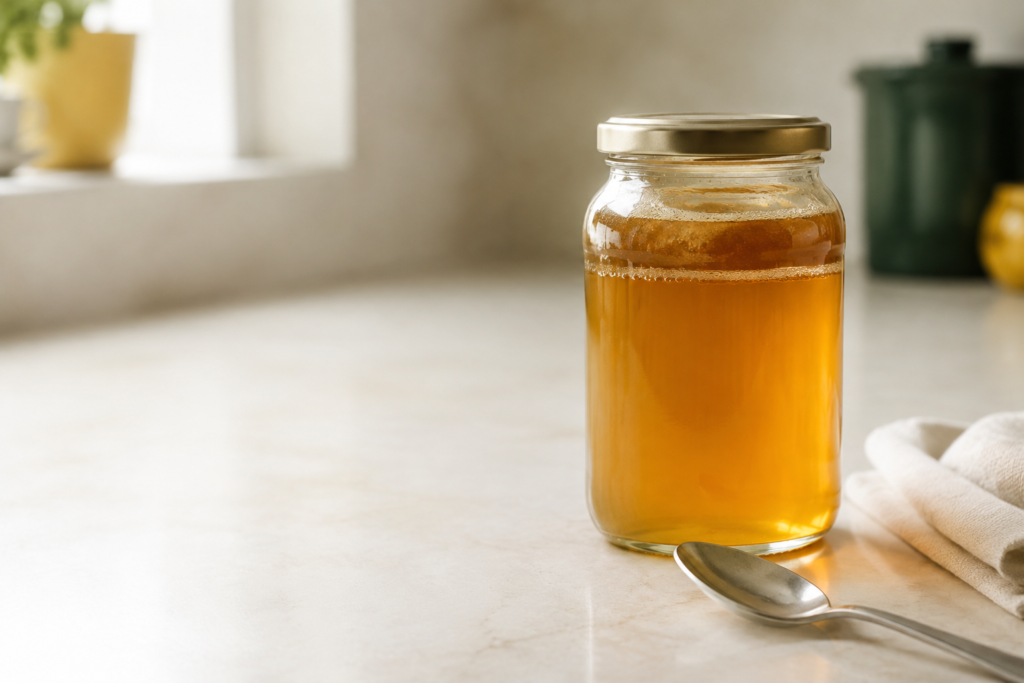
THE COMPLETE HONEY FERMENTATION GUIDE Why Does Honey Ferment? Signs, Causes and Prevention Unintended honey fermentation usually begins when yeasts can use

Does Honey Need to Be Refrigerated? What Happens in the Fridge
THE COMPLETE COLD-STORAGE GUIDE Does Honey Need to Be Refrigerated? What Happens in the Fridge Plain honey usually belongs in a dry
Frequently asked questions
What is beekeeping called?
Beekeeping is also called apiculture. A beekeeper may be called an apiarist or apiculturist.
What is a group of beehives called?
A location containing managed hives or colonies is an apiary or bee yard. The living bees in one organized society form a colony.
What is brood in beekeeping?
Brood means developing bees—eggs, larvae and pupae—before they emerge as adults.
What is a honey super?
A honey super is a hive box intended mainly for bees to store surplus honey that may later be harvested.
What is the difference between a frame and comb?
The frame is removable equipment that supports the wax comb. Comb is the sheet of wax cells built and used by bees.
What does “queenright” mean?
Queenright means a colony has a functional queen. Beekeepers often infer this from eggs, young brood, colony behavior and direct queen observation.
Is every colony loss colony collapse disorder?
No. Colony collapse disorder is a defined syndrome. Colonies can die or fail for many other reasons, including parasites, starvation, queen problems, disease and environmental stress.
Why do definitions differ between countries?
Hive designs, equipment dimensions, common names and laws vary. This glossary gives broadly used meanings and flags terms requiring local confirmation.
How this beekeeping glossary was researched
Definitions were checked against international beekeeping references, agricultural authorities and primary honey bee resources. Language is simplified without turning local conventions into universal rules.
- FAO: Some apicultural terms
- FAO Global Action on Pollination Services: Glossary
- USDA: Beekeeping in the United States
- USDA National Agricultural Library: Apiculture and Beekeeping
- Ontario Beekeepers’ Association: Getting Started
- USDA Bee Research Laboratory: Colony Collapse Disorder overview
Keep exploring the world inside the hive
Use the glossary as your starting point, then move into complete guides to honey bee biology, colony life and responsible beekeeping.