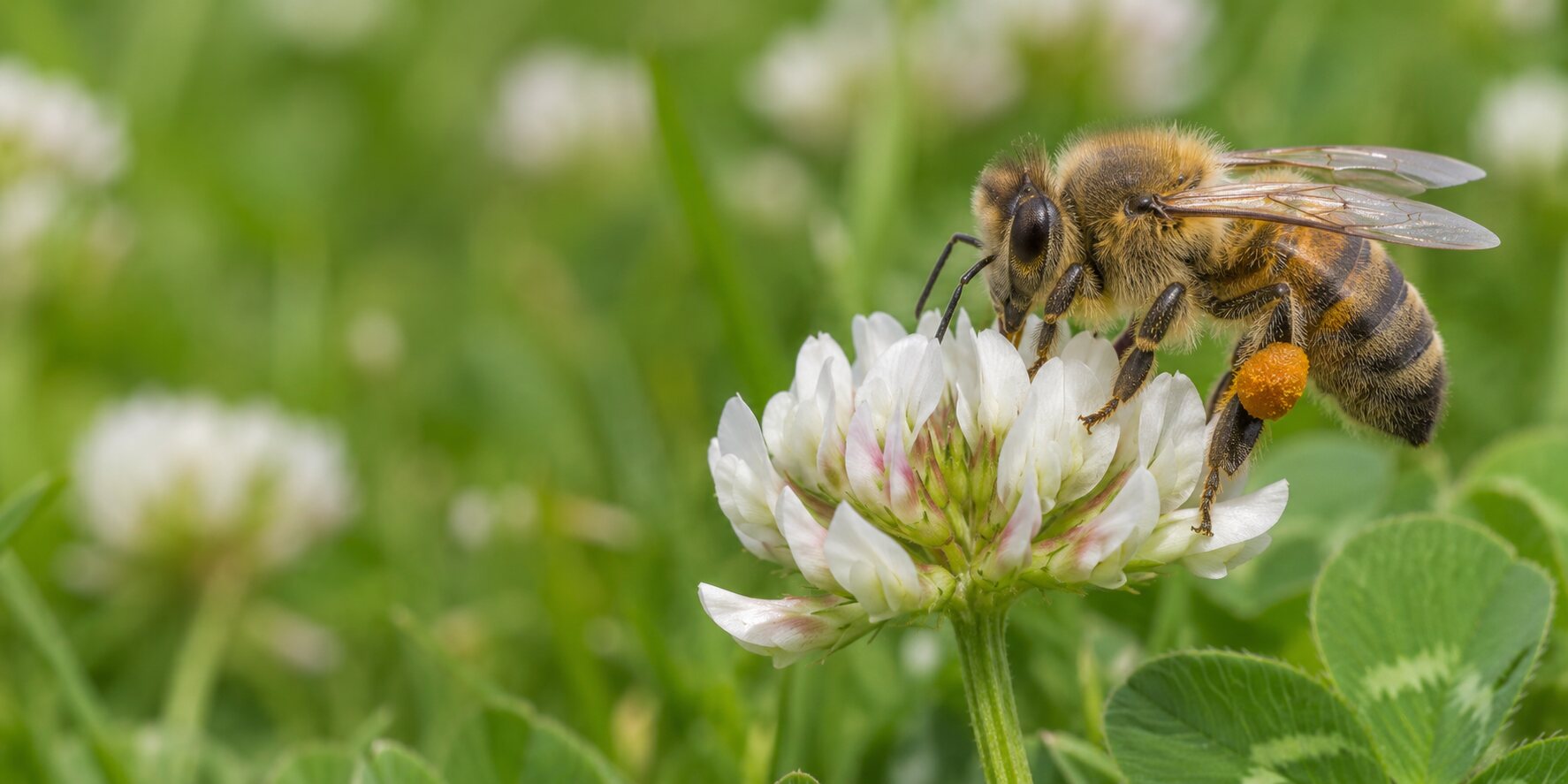
A bee turns on a flower and suddenly looks as though it’s wearing two orange saddlebags. On a worker honey bee, those rounded loads are usually pellets of pollen. Each sits on the outside of a hind leg, in a structure called a corbicula, or pollen basket. The yellow or orange you see belongs to the load. A bee can leave the hive with the baskets empty.
Where is the basket?
Look at the broad section of the back leg between the knee-like bend and the foot. On a honey bee worker, a fringe of long hairs borders a relatively smooth area. This is an open carrying surface. A loaded basket can be easier to see side-on than from above because the pellet bulges beyond the outline of the leg. Pollen-gathering bumble bee workers also have baskets, so the presence of two pellets alone won’t identify a honey bee.
How the loose dust becomes a pellet
The flower’s anthers release pollen grains. As the bee moves about, grains catch on its body hairs. The worker grooms pollen toward the back legs and moistens it with liquid carried in its crop. Gradually the grains hold together well enough to travel as a lump. You can watch a worker arrive dusty and later fly off with two quite tidy loads.
Pollen and nectar take different routes home. A worker carries a nectar load internally in the crop. The colourful parcels are pollen, which supplies the colony with protein and fats. In the hive, workers pack collected pollen into comb cells, where the stored food is often called bee bread. The pellets do not turn into honey.
Why some pollen-covered bees have bare-looking legs
Many bees carry pollen in a brush of hairs called a scopa. Depending on the bee, the brush can be on the legs or under the abdomen. Watch a female leafcutter bee lift off a blossom and you may glimpse a bright stripe running along her belly. Seen from above, the same bee can appear almost clean.
There are also visits when a bee simply carries no obvious pollen load. A honey bee may be gathering nectar, or you may be seeing it early in a pollen trip. Loose grains can still touch the next flower. An empty-looking basket is a poor test of whether the visit helped to transfer pollen.
Try this on the next flowering patch
Pick one blossom and let the bee come into view. Take a side photograph as it turns, then another as it leaves. Record three things separately: the flower you actually saw it visit, the position of the load, and its colour. “Orange pellet on hind leg, seen on a daisy” is a sound observation. Calling that pellet pure daisy pollen goes further than the photograph can support.
For a closer look at the carrier itself, see our western honey bee profile. The Canadian Wildlife Federation’s guide to bees compares carrying structures, and research on stored pollen in honey bee colonies explains how the material is packed and used.
Read a pollen load from two angles
Start with a side view. A worker honey bee carrying a load often shows a compact pellet on the outside of each hind leg. As it turns, the pellet moves with the leg. Now watch a leafcutter bee from slightly below while it reaches into a flower. Many female leafcutters carry loose pollen in a brush of hairs along the underside of the abdomen. From above, that brush can be almost invisible.
In your notes, sketch the position before naming a colour. Two orange patches beside the legs, a stripe under the belly and a dusting across the face describe three different things. If you saw only the back of the bee, record the angle and leave the load position open. Photographing another visit from the side is more reliable than guessing from yellow specks alone.