
Acacia Honey: Taste, Origin, Benefits and Why It Stays Liquid
Acacia honey is a very pale, mild monofloral honey made primarily from the white blossoms of black locust, Robinia pseudoacacia. Its clean sweetness and high fructose-to-glucose ratio often keep it liquid much longer than many other honey varieties.
This global guide explains the confusing name, flavor and color, major producing regions, crystallization behavior, nutrition, culinary uses and the evidence needed to verify authentic origin.
What is acacia honey?
In most European and international honey markets, “acacia honey” means honey from black locust blossoms—not nectar from trees in the botanical genus Acacia. It is typically almost clear to pale straw, gently floral and slow to crystallize.
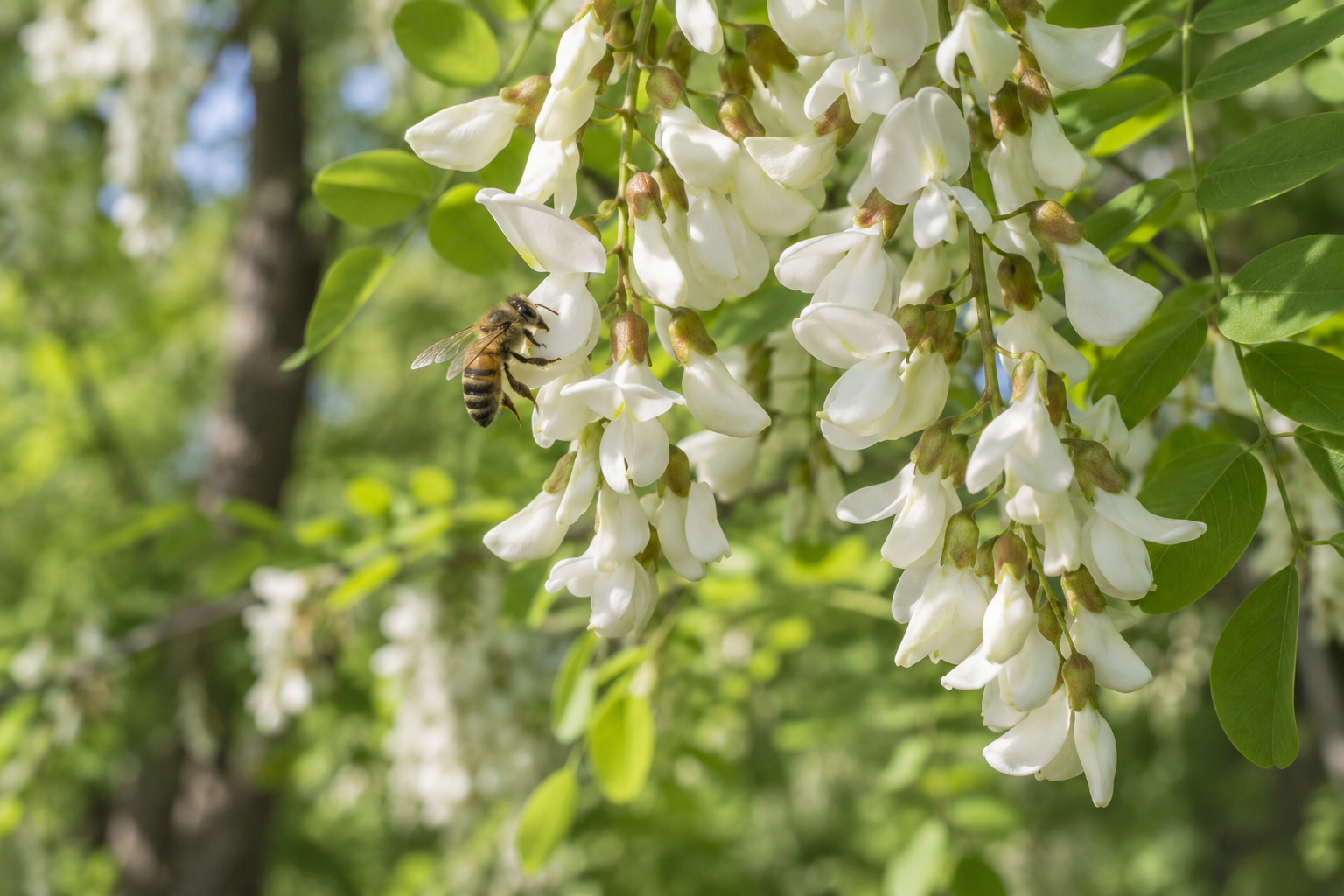
A honey bee visits the fragrant white flower clusters of black locust, Robinia pseudoacacia—the tree responsible for most honey sold internationally as acacia honey.
Acacia honey—from black locust bloom to pale liquid honey
Contents
What acacia honey is
Black locust produces pendulous clusters of white, pea-shaped flowers during a relatively brief bloom. When weather and tree density allow bees to collect predominantly from those blossoms, the harvest can express a recognizable black locust—or “acacia”—profile.
Monofloral does not mean that every drop came from one plant. It means the target source dominates the honey’s botanical, sensory and analytical character.
Black locust
Robinia pseudoacacia, a legume tree native to North America and widely planted elsewhere.
Water-white to pale straw
Among the lightest commonly marketed monofloral honeys.
Slow crystallization
A high fructose-to-glucose balance often keeps it pourable.
Is acacia honey really made from acacia trees?
Usually not. European “acacia honey” comes chiefly from black locust, a North American tree once classified near plants called acacias and given the species name pseudoacacia—meaning false acacia. The trading name persisted after botanical classification became clearer.
| Name used | Usually refers to | Important distinction |
|---|---|---|
| Acacia honey | Black locust honey in Europe and many export markets | Normally Robinia pseudoacacia |
| Black locust honey | The same main botanical source | Clearer name in North America |
| False acacia honey | Direct translation used in some regions | Also refers to Robinia pseudoacacia |
| True Acacia honey | Honey from species in the genus Acacia or related classifications | A different botanical product whose identity depends on region |
Taste, color and how acacia honey compares
Acacia honey is valued for sweetness without a heavy aftertaste. Descriptions often include light floral, vanilla-like and faintly fruity notes, but harvests vary.
| Feature | Acacia honey | Clover honey | Orange blossom honey | Wildflower honey |
|---|---|---|---|---|
| Typical color | Almost clear to pale straw | Pale to light amber | Light amber | Light to very dark |
| Flavor strength | Very mild | Mild | Mild to medium | Highly variable |
| Common notes | Clean floral, vanilla-like | Soft floral, grassy | Floral, citrus-like | Depends on local bloom |
| Crystallization | Often very slow | Moderate | Moderate | Varies widely |
| Best when | A subtle sweetener is wanted | Everyday versatility matters | Aromatic floral character helps | Regional complexity is desired |
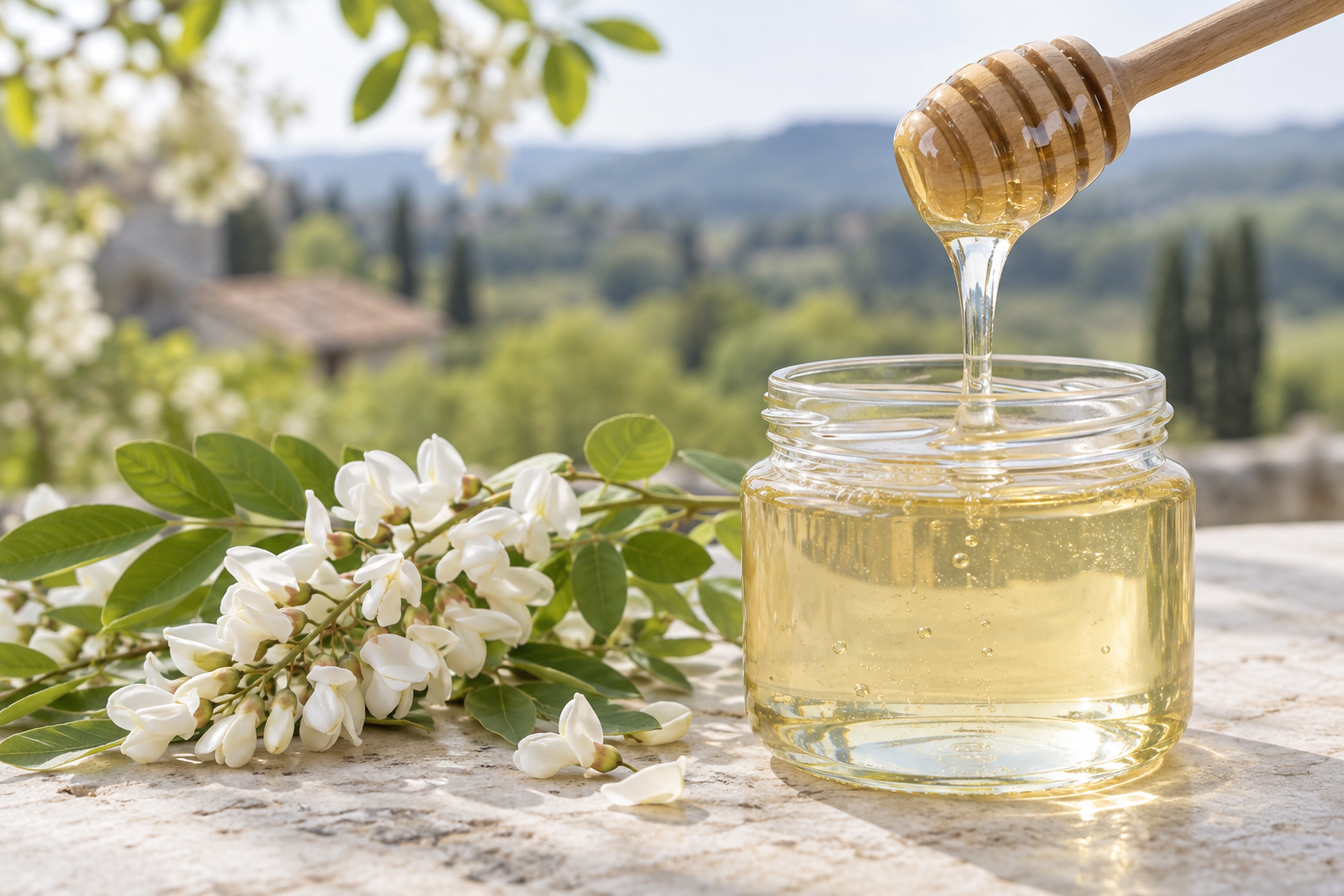
Authentic black locust honey is often exceptionally pale and remains fluid for a long time, but color alone cannot prove botanical origin.
How and where acacia honey is produced
Black locust blooms for a short period, and rain, wind, frost or cool temperatures can sharply reduce nectar collection. Beekeepers may position colonies near dense flowering stands and harvest after the flow to preserve a recognizable monofloral character.
Important production areas include Hungary, Romania, Bulgaria, Serbia, Croatia, Italy, France, Ukraine, China and parts of North America. Hungarian acacia honey is especially prominent in European trade and includes protected regional traditions, but high-quality black locust honey is not limited to one country.
Why acacia honey stays liquid so long
Honey crystallizes when glucose leaves the liquid phase and forms crystals. Black locust honey commonly contains substantially more fructose than glucose, so fewer glucose crystals form under ordinary storage conditions.
| Factor | Effect on crystallization | Acacia honey pattern |
|---|---|---|
| Fructose-to-glucose ratio | More fructose generally slows crystal formation | Often relatively high |
| Water content | Changes sugar concentration and stability | Varies by harvest and ripening |
| Pollen and particles | Can provide crystal nucleation sites | Filtration and handling affect abundance |
| Temperature | Some cool ranges promote crystallization | Storage conditions still matter |
Important: slow crystallization is characteristic, not a guarantee. Real acacia honey can eventually crystallize, and permanently liquid honey is not automatically authentic.
Nutrition, potential benefits and culinary uses
Acacia honey is primarily fructose, glucose and water, with small amounts of acids, enzymes, aroma compounds and plant-derived constituents. It supplies quick carbohydrate energy, but claims that it detoxifies the body, controls disease or has unique clinical benefits are not established.
Its greatest practical advantage is culinary: mild flavor and long-lasting fluidity. Use it in tea, yogurt, soft cheese, fruit, vinaigrettes, delicate cakes or anywhere a stronger honey would dominate.
How to choose authentic acacia honey
Botanical identity is strongest when several kinds of evidence agree: a named harvest region, producer traceability, sensory characteristics, pollen analysis and physicochemical testing. Because black locust pollen can be underrepresented in honey, experts may use more than pollen percentage alone.
- Look for: producer, country or region, harvest information and botanical naming.
- Do not rely on: pale color, “raw” language or slow crystallization by themselves.
- Storage: keep tightly closed in a dry cupboard at room temperature.
- Safety: never give any honey to a child younger than 12 months.
Related honey variety guides
Continue exploring how plant source shapes flavor, color and texture.
Orange Blossom Honey
Compare another pale, aromatic monofloral honey.
Clover Honey
Understand one of North America’s familiar mild honeys.
Types of Honey
Explore floral, forest and regional honeys worldwide.
Latest honey variety, flavor and authenticity guides
Continue with current Hive To Honey articles covering botanical origins, regional honeys, crystallization, quality and storage.
Why Is My Honey Foamy? Bubbles, Wax or Fermentation Explained
THE COMPLETE HONEY FOAM GUIDE Why Is My Honey Foamy? Bubbles, Wax or Fermentation Explained Foam on honey is not automatically spoilage.
Why Does Honey Ferment? Signs, Causes and Prevention
THE COMPLETE HONEY FERMENTATION GUIDE Why Does Honey Ferment? Signs, Causes and Prevention Unintended honey fermentation usually begins when yeasts can use
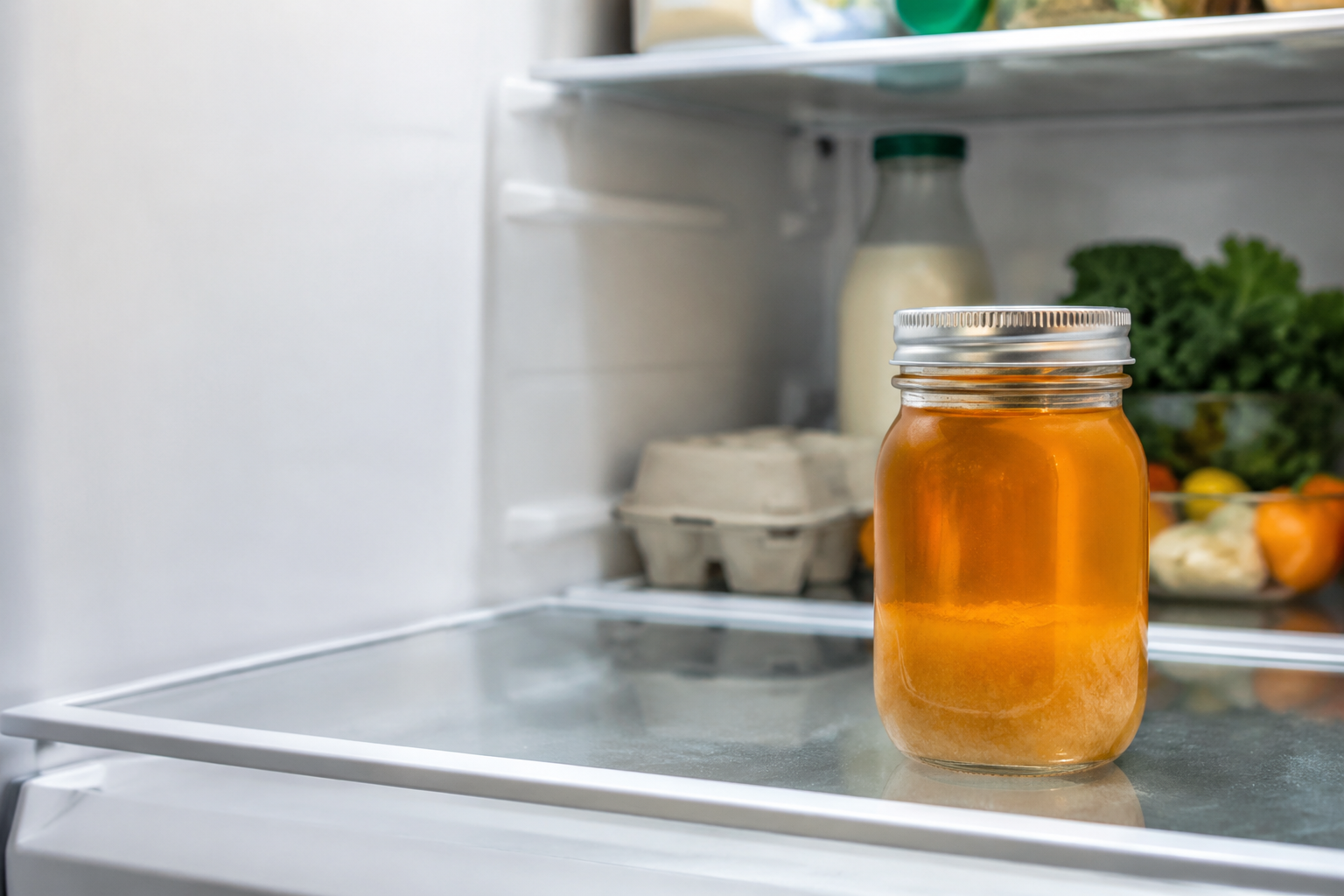
Does Honey Need to Be Refrigerated? What Happens in the Fridge
THE COMPLETE COLD-STORAGE GUIDE Does Honey Need to Be Refrigerated? What Happens in the Fridge Plain honey usually belongs in a dry
Acacia honey: frequently asked questions
What does acacia honey taste like?
It is usually very mild and clean, with delicate floral, vanilla-like or faintly fruity notes.
Is acacia honey made from true acacia?
Most honey sold internationally under this name comes from black locust, Robinia pseudoacacia, rather than the botanical genus Acacia.
Why is acacia honey almost clear?
Black locust nectar naturally produces one of the palest common monofloral honeys. Color still varies by harvest and handling.
Why does it crystallize slowly?
Its sugar profile commonly contains a high proportion of fructose relative to glucose, slowing crystal formation.
Is acacia honey healthier than other honey?
No unique clinical advantage is established. Like other honey, it is primarily sugar and water with smaller amounts of other compounds.
How can I tell if acacia honey is authentic?
Choose traceable producers and credible origin information. Color and liquidity alone are not proof; laboratory analysis may be needed for verification.
Black locust honey, authenticity and quality sources
- Codex Alimentarius Commission. International Standard for Honey.
- European Commission. Geographical indications and quality schemes.
- Plants of the World Online, Royal Botanic Gardens, Kew. Taxonomic reference for Robinia pseudoacacia.
- National Library of Medicine, PubMed. Research on black locust honey composition.
- National Library of Medicine, PubMed. Research on acacia honey authentication.
Composition and sensory properties vary by region, weather, harvest, colony, processing, storage and analytical method.
Compare acacia honey with varieties worldwide
Explore how flowers, forests, climate and place shape every jar.
Discover types of honey →