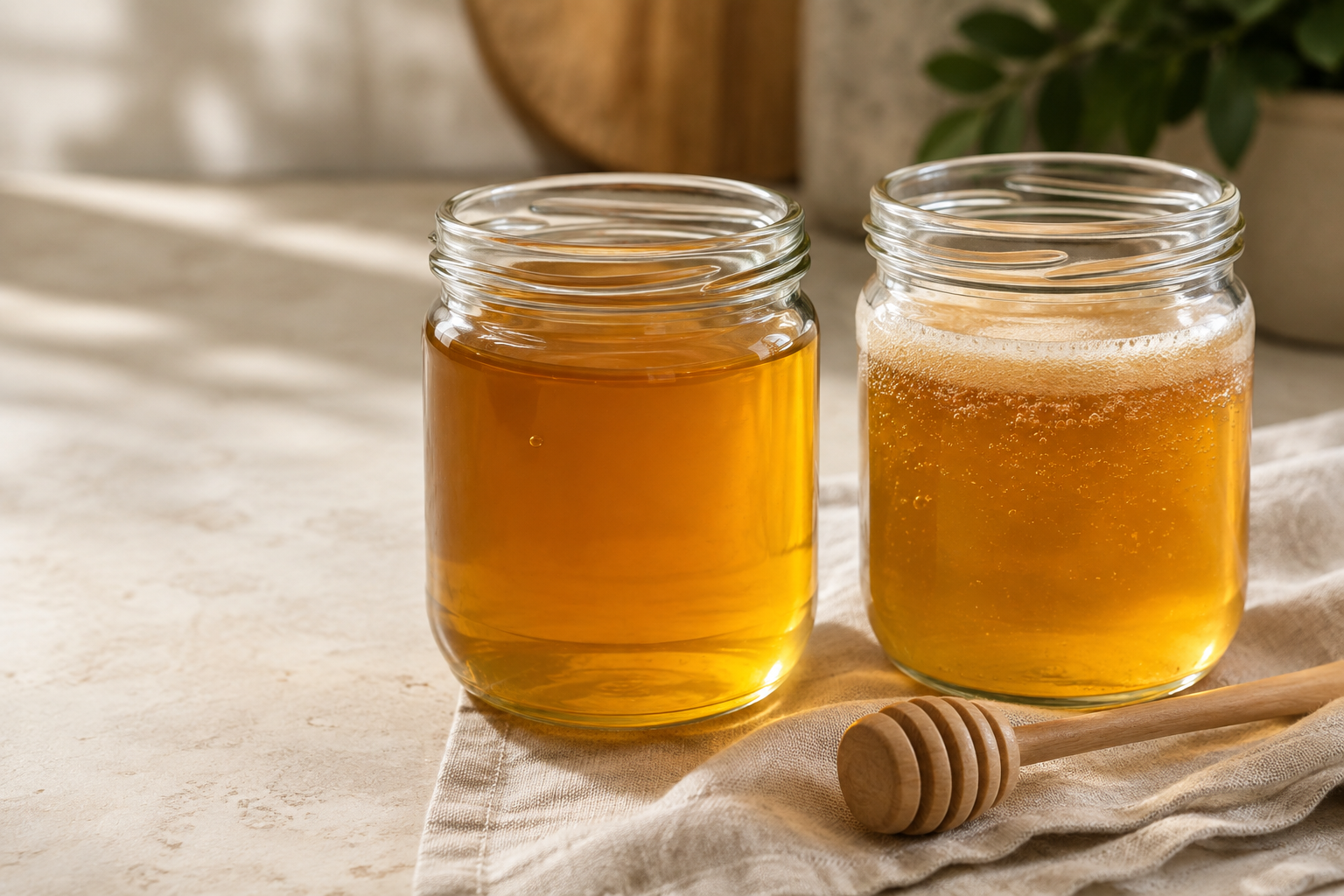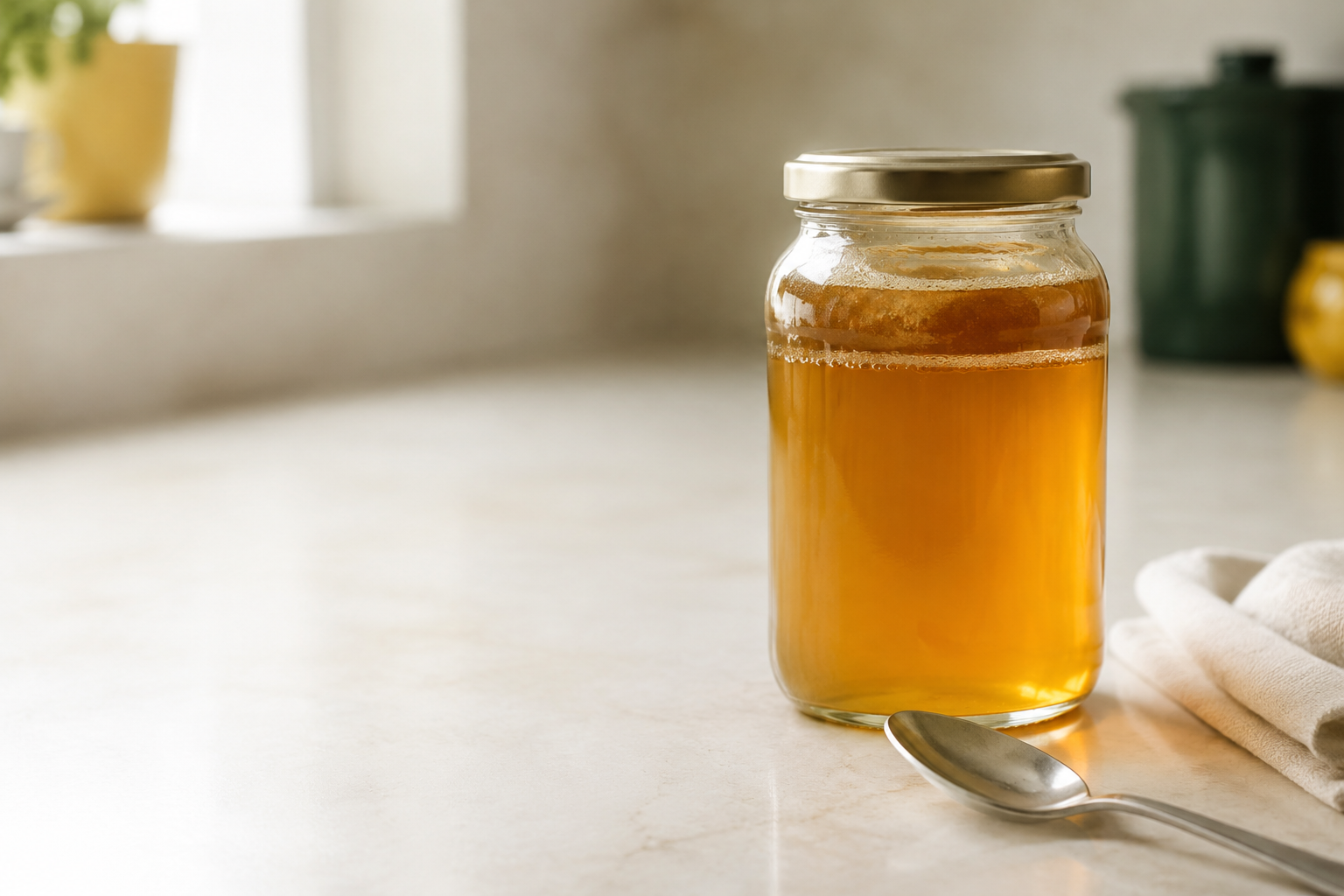
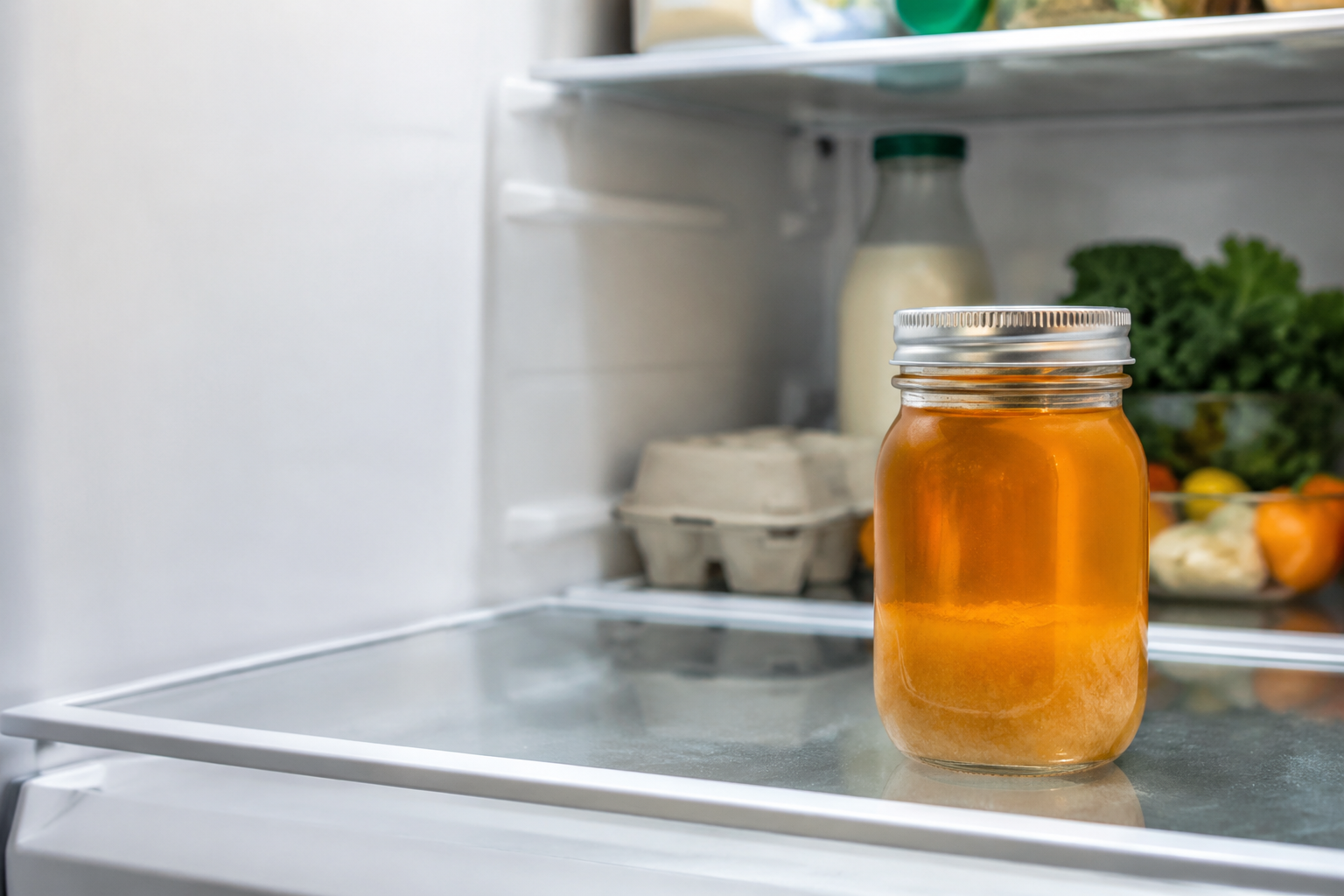
Does Honey Need to Be Refrigerated? What Happens in the Fridge
Plain honey usually belongs in a dry cupboard—not the refrigerator. Learn why cold honey thickens and crystallizes, when label instructions take priority, and how storage differs for raw, creamed, comb and infused honey.
Plain honey generally does not need refrigeration
- Store plain honey tightly sealed in a dry cupboard away from excessive heat.
- Refrigeration makes honey thicker and commonly promotes or hardens crystallization.
- Cold-induced crystals are a texture change—not automatic evidence of spoilage.
- Keep the lid closed and use only clean, completely dry utensils.
- Follow the label for infused, blended or otherwise formulated honey products.
- Warm refrigerated honey gradually when you want a pourable texture again.
Find the refrigeration answer you need
Why plain honey usually stays in the pantry
Naturally low water activity
Naturally acidic
Refrigeration adds inconvenience
Pantry vs. refrigerator vs. freezer
| Location | Best use | Likely effect on plain honey |
|---|---|---|
| Dry pantry or cupboard | Best everyday choice | Keeps honey convenient while protecting it from light, humidity and excessive heat |
| Refrigerator | Usually unnecessary unless the label requires it | Raises viscosity and commonly encourages or hardens crystals |
| Freezer | Optional specialized or portioned storage | Makes honey extremely thick; packaging and gradual thawing matter |
| Sunny countertop | Avoid prolonged exposure | Light and heat can accelerate quality changes |
| Beside an oven | Avoid | Repeated warmth and temperature swings can diminish quality |
For the ordinary opened jar, a stable cupboard usually provides the best balance of quality, accessibility and texture.
What happens when honey is refrigerated?
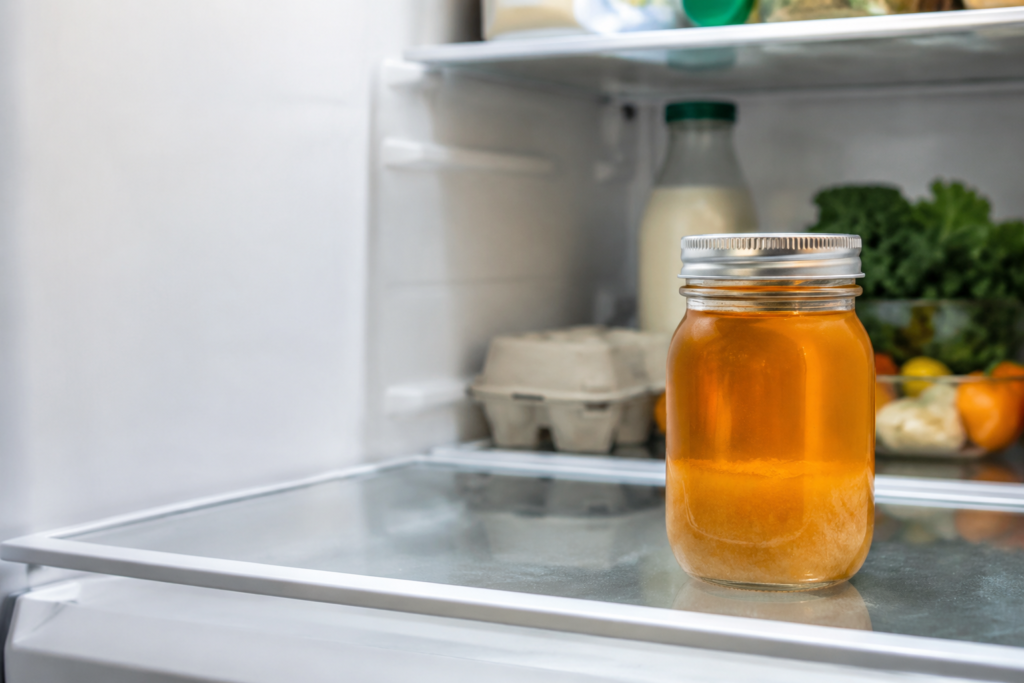
Refrigerated honey can look dramatically different while remaining the same food. Its precise response depends on floral source, moisture, glucose-to-fructose balance, particles and existing crystals.
It becomes more viscous
Crystals may form or harden
The jar may appear cloudy
Layers can appear
Aroma seems quieter
Condensation becomes a concern
Should honey be refrigerated after opening?
Keep the original label and lot code. Date and storage language varies between markets, and the producer knows the complete formulation.
Raw, creamed, comb and infused honey
Raw honey
Creamed honey
Comb honey
Infused or blended honey
Do not generalize: advice for plain honey does not automatically apply to honey sauces, whipped blends, fermented products or homemade infusions.
When might honey need refrigeration?
Formulated products
A product sold as infused honey, honey spread, sauce or mixture may contain ingredients that reduce the natural stability associated with plain honey. Refrigerate after opening when the label directs you to do so.
Homemade mixtures require a validated recipe and handling method. Adding water or fresh plant material to honey can create conditions unlike those in the original jar.
Climate and household conditions
High humidity makes a reliable seal especially important, but refrigeration is not a substitute for keeping moisture out. Extremely warm storage locations should be avoided; choose the coolest suitable dry cupboard available.
If a producer gives specific instructions for a regional or specialty product, follow those instructions rather than a general internet rule.
How to restore refrigerated honey
Keep the jar closed
Give it time
Use indirect warmth if needed
Stir only when dry
When crystals persist, they are usually normal. Use the honey as a spread or follow the complete gentle decrystallizing method.
Common refrigeration mistakes
Safety and quality checks
Refrigeration can change texture, but it cannot reverse contamination, fermentation or package damage.
Never for infants
Watch for fermentation
Inspect the package
Check recalls
Avoid taste-testing uncertainty
Treat medical use separately
Frequently asked questions about refrigerating honey
Does honey need to be refrigerated?
Plain honey generally does not need refrigeration. Store it tightly sealed in a dry cupboard unless its label gives different directions.
Should honey be refrigerated after opening?
Opening plain honey does not normally create a refrigeration requirement. Keep the lid tight and use clean, dry utensils.
What happens if honey is refrigerated?
It becomes more viscous and commonly crystallizes or hardens, making it harder to pour. These texture changes are not automatically spoilage.
Does raw honey need refrigeration?
Plain raw honey generally does not require routine refrigeration. Protect it from moisture and unnecessary heat and follow its label.
Should creamed honey be refrigerated?
Producer directions vary because refrigeration can affect the intended fine-crystal texture. Follow the product label.
Can I leave refrigerated honey on the counter?
Keep the jar sealed and allow it to warm gradually. Return plain honey to a suitable dry cupboard after it reaches normal serving texture.
How do I liquefy refrigerated honey?
First let it warm gradually. If crystals remain, place the sound jar in warm—not boiling—water, keep water below the lid and avoid thermal shock.
Can infused honey stay in the pantry?
Not necessarily. Added ingredients can change storage requirements. Follow the manufacturer’s label or a validated recipe.
Latest Honey Storage & Care guides
Continue with practical guides covering shelf life, freezing, crystallization, containers and responsible storage.
Why Is My Honey Foamy? Bubbles, Wax or Fermentation Explained
THE COMPLETE HONEY FOAM GUIDE Why Is My Honey Foamy? Bubbles, Wax or Fermentation Explained Foam on honey is not automatically spoilage.
Why Does Honey Ferment? Signs, Causes and Prevention
THE COMPLETE HONEY FERMENTATION GUIDE Why Does Honey Ferment? Signs, Causes and Prevention Unintended honey fermentation usually begins when yeasts can use
Does Honey Need to Be Refrigerated? What Happens in the Fridge
THE COMPLETE COLD-STORAGE GUIDE Does Honey Need to Be Refrigerated? What Happens in the Fridge Plain honey usually belongs in a dry
Continue learning about honey care
How this refrigeration guide was researched
This guide prioritizes university extension advice, international honey references and government food-safety guidance. It distinguishes plain honey from formulated products whose labels may require refrigeration.
- Penn State Extension: Storing Staple Ingredients in the Kitchen
- Utah State University Extension: Storing Sugars
- FAO: Honey composition and crystallization
- FAO: Moisture and honey processing
- FAO: Honey storage and temperature
- FAO/WHO Codex Standard for Honey
- Canadian Food Inspection Agency: Honey labeling requirements
- Food Standards Australia New Zealand: Storing food safely
Give plain honey a dry cupboard, not unnecessary refrigeration
A tight lid, clean dry utensil and stable cupboard keep ordinary honey convenient. Reserve refrigeration for products whose ingredients or label actually require it.