
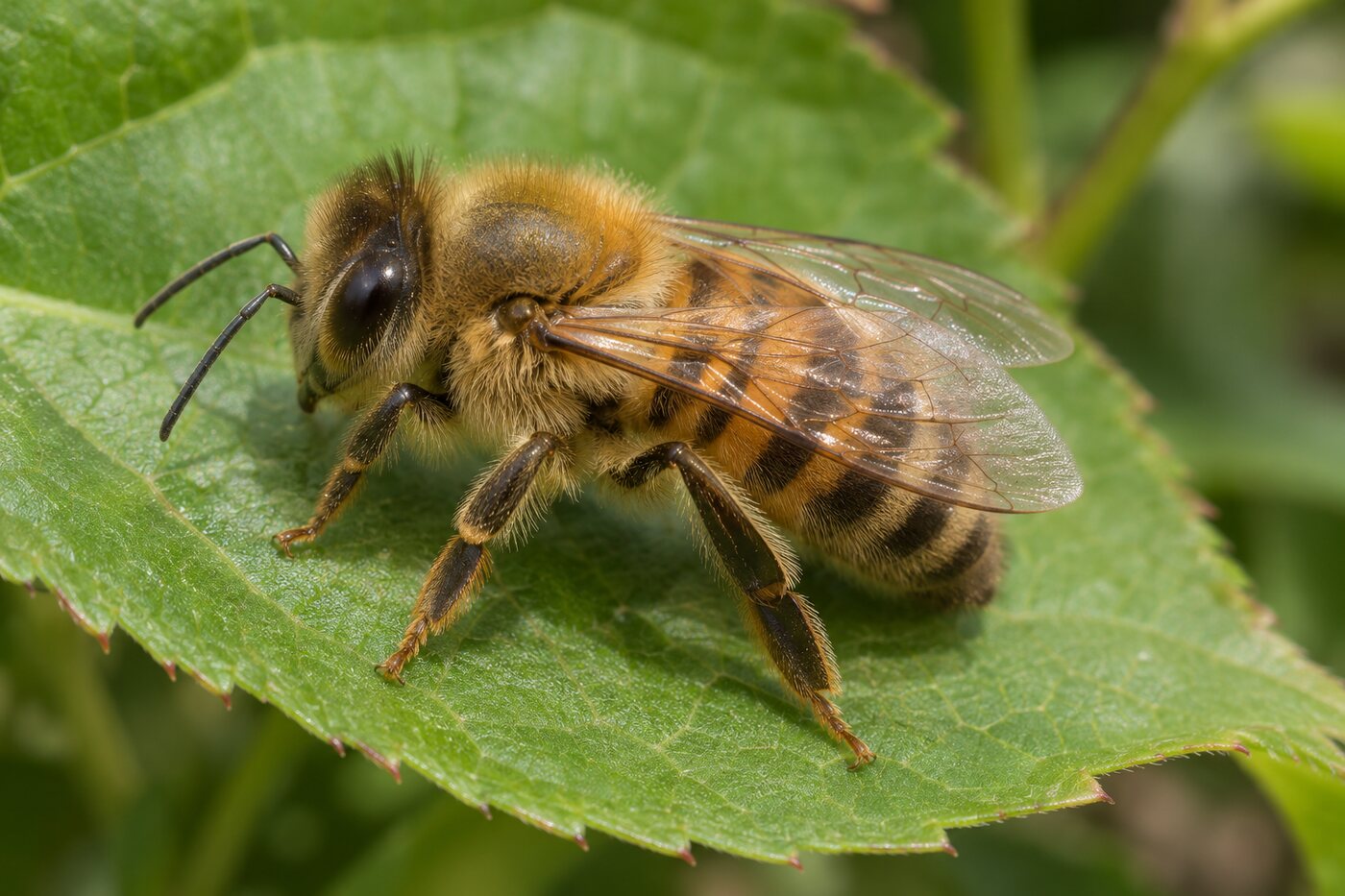
A honey bee has four wings, two on each side of its thorax. The larger front wing can cover most of the smaller rear wing when the bee rests on a leaf. Even in flight, the two on each side can look like one. A row of minute hooks joins their edges so they move together.
Where to look for the hindwing
Start at the bee’s shoulders, just behind its head. Follow the long front edge of the larger wing towards the tip. Now return to the shoulder and trace the outline behind that wing. If the bee has shifted its wings slightly apart, a second, shorter edge appears. That’s the hindwing on the same side of the insect.
The dark lines running inside the transparent membrane are veins. Counting the little windows they enclose won’t tell you how many wings you’re looking at. Trace the outside margins instead. A view from slightly above and to one side is often easier to read than a picture taken directly from above.
How do the wings stay together in flight?
The hooks are called hamuli. They sit along the front edge of the hindwing and catch a folded margin on the back edge of the forewing. Picture two sheets meeting along a seam. Each sheet still has its own attachment to the thorax, while the joined surfaces can push against the air together. At rest the bee can uncouple the wings and fold them along its back.
For a magnified view of the actual joint, look at the wing plates in the USDA’s Atlas of the Honey Bee. The University of Arkansas honey bee anatomy guide places both pairs on the whole insect.
Does seeing two wings mean you photographed a fly?
True flies have one pair of flight wings, making a clear wing count a useful clue. A photograph showing only two visible outlines is a weaker clue. Overlap, blur, glare and the bee’s far side being hidden can all change the apparent count. Watch a resting insect turn or take a short sequence as it leaves a flower. Two different angles often reveal more than zooming in on the same frame.