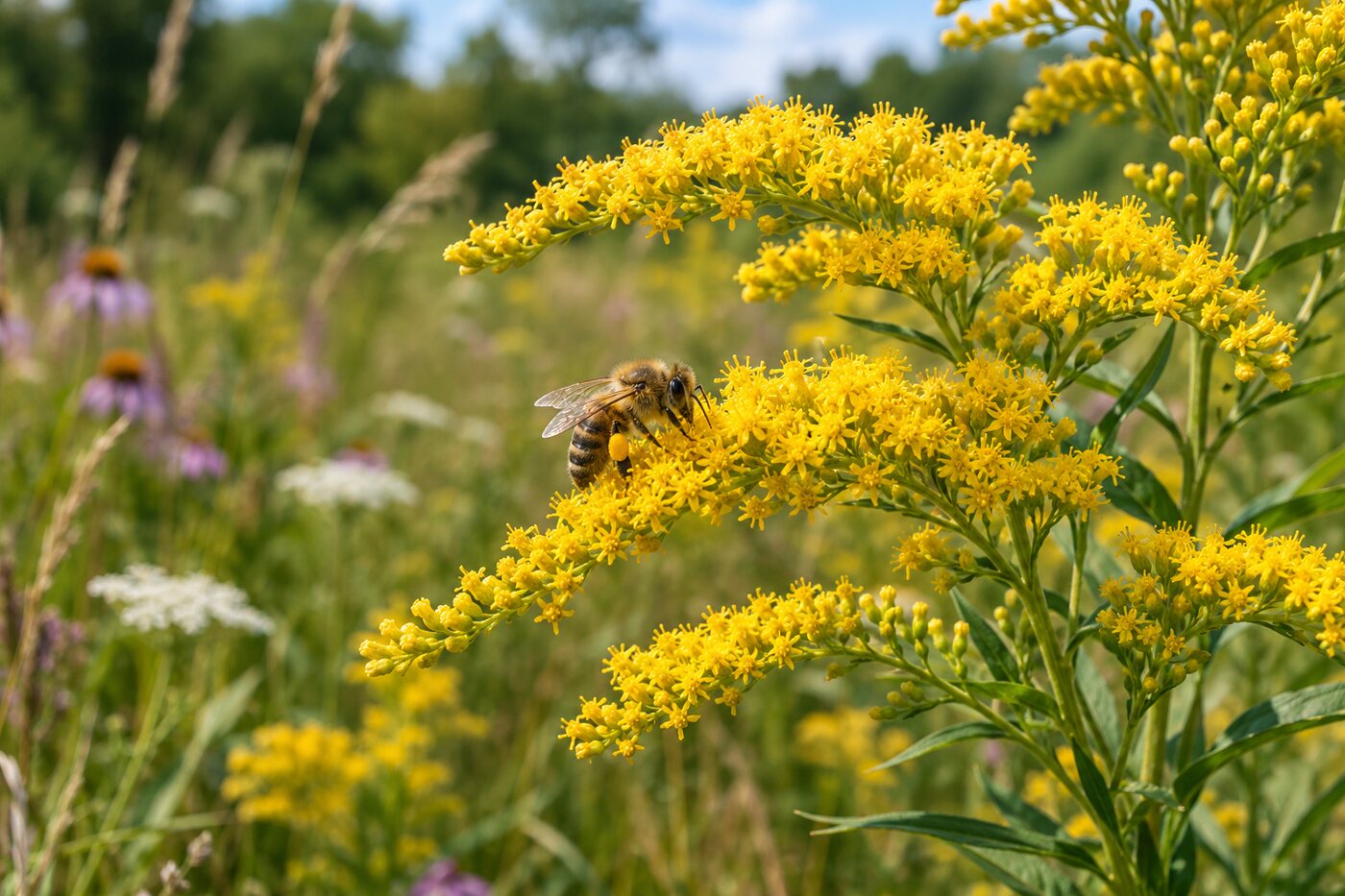
A sweep of yellow flowers beside a late-summer path often gets called ragweed. Walk up to one flowering stem. If the yellow resolves into dozens of tiny, open, daisy-like heads along branching sprays, you are likely looking at goldenrod. Common ragweed carries much less conspicuous greenish flower heads. The two plants can grow together, so trace the flower cluster down to the leaves on that very stem.
Start with the flower heads
On many familiar goldenrods, the branches bend outward under the weight of the little yellow heads. A bee can walk from head to head without taking flight. Other goldenrods hold their flowers more upright, so the yellow composite heads are a better first clue than the silhouette of the whole plant.
On common ragweed, look toward the top for slender spikes carrying small greenish, bead-like male flower heads. From the far side of a ditch the plant can look as though it has scarcely begun to bloom, even while the male flowers are shedding pollen. A close photograph from the side will capture the shape more clearly than an overhead shot.
Check a leaf on the flowering stem
The leaves of common ragweed are deeply divided, with a lacy outline. The familiar plume-forming goldenrods often have narrow, pointed leaves with a single undivided blade. Take one picture of the flower and another showing a leaf attached to its stem. A single frame crowded with leaves from neighbouring plants can make a perfectly ordinary patch look like a botanical puzzle.
These clues distinguish common ragweed from many familiar goldenrods. For a species-level identification, include the whole plant and your region. Giant ragweed, for example, has a different leaf shape from common ragweed.
What does a visiting bee tell you?
Goldenrod offers nectar and pollen late in the growing season. Common ragweed relies mainly on wind to move pollen. The difference helps explain why a flowering goldenrod patch can hum with visitors while a ragweed spike beside it looks quiet. Identify the plant from the flowers and leaves first. An insect can land on either.
Try watching one spray for a minute and following a single visitor. Is it probing several heads, grooming its legs, or simply resting? That note gives a better record of the visit than a tally alone. Equally, one busy patch cannot establish the floral origin of a nearby beekeeper’s entire crop. Our Canadian wildflower honey guide explains how overlapping blooms shape a harvest. For photographs of both plants, see Clemson Extension’s identification guide.