
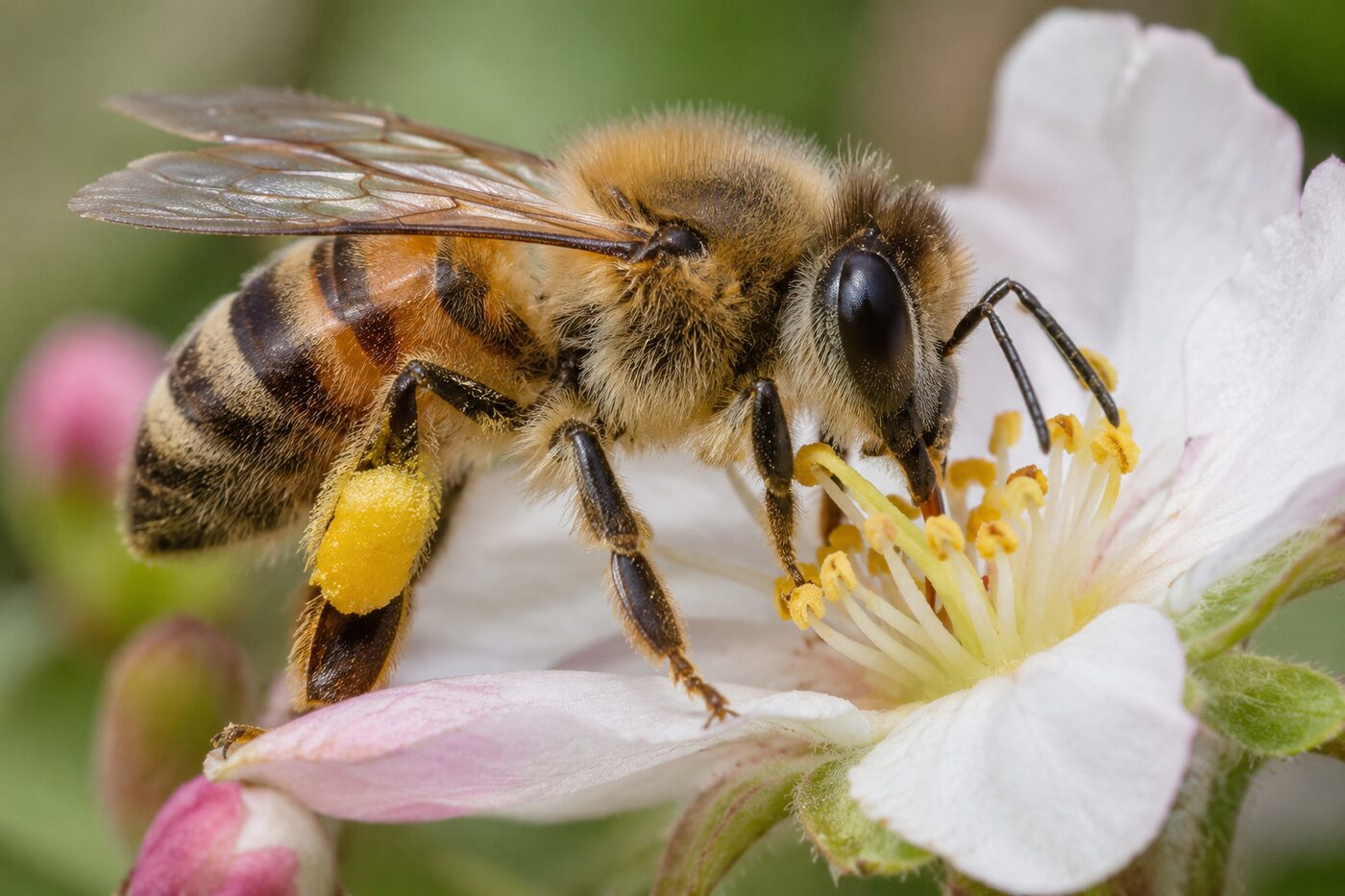
A honey bee has five eyes. The two large, curved eyes on the sides of its head are compound eyes. The other three, called ocelli, look like tiny shiny beads. On a worker they form a triangle near the crown of the head. If you have only seen bees in profile on flowers, there is a good reason you missed them: that angle shows off one compound eye and hides much of the crown.
Two compound eyes for seeing the scene
Look at a sharp close-up of the side of a bee’s head. What appears to be one smooth dark oval from across the garden breaks up into tiny facets. Each facet belongs to a visual unit that samples part of the bee’s surroundings. Together the units supply information about shapes, movement and colour as the bee flies or approaches a flower.
Counting facets is a different exercise from counting eyes. Think of the whole curved, faceted surface as one eye. A tiny reflection on that surface moves when the lighting or the camera angle changes. It can make a convincing extra “eye” in a phone picture.
Three simple eyes for sensing light
Each ocellus has a single lens. These small eyes pick up changes in illumination and help provide visual orientation during flight. They give the bee another source of information as it moves between open sky and shade. The broad side eyes do most of the work of seeing the detail of the scene around it.
On a worker, locate the two antennae first. Then look above their bases, between the large eyes, where short hairs can obscure the three little lenses. A view from slightly above is often much more revealing than a front-on portrait. There is no need to catch a bee to do this. Use a sharp photograph and enlarge the head.
Why the eyes look different on a drone
A male honey bee, or drone, also has five eyes. Its compound eyes are so large that they meet on top of its head. The three simple eyes sit farther forward on the face. Using a diagram of a worker to identify the eyes on a drone can leave you searching the wrong spot.
The University of Florida’s honey bee project book shows the eyes on a labelled head. For a close look at the differences between castes, compare the images in the USDA Atlas of the Honey Bee. Our guide to workers, queens and drones follows those differences through the colony’s life cycle.