
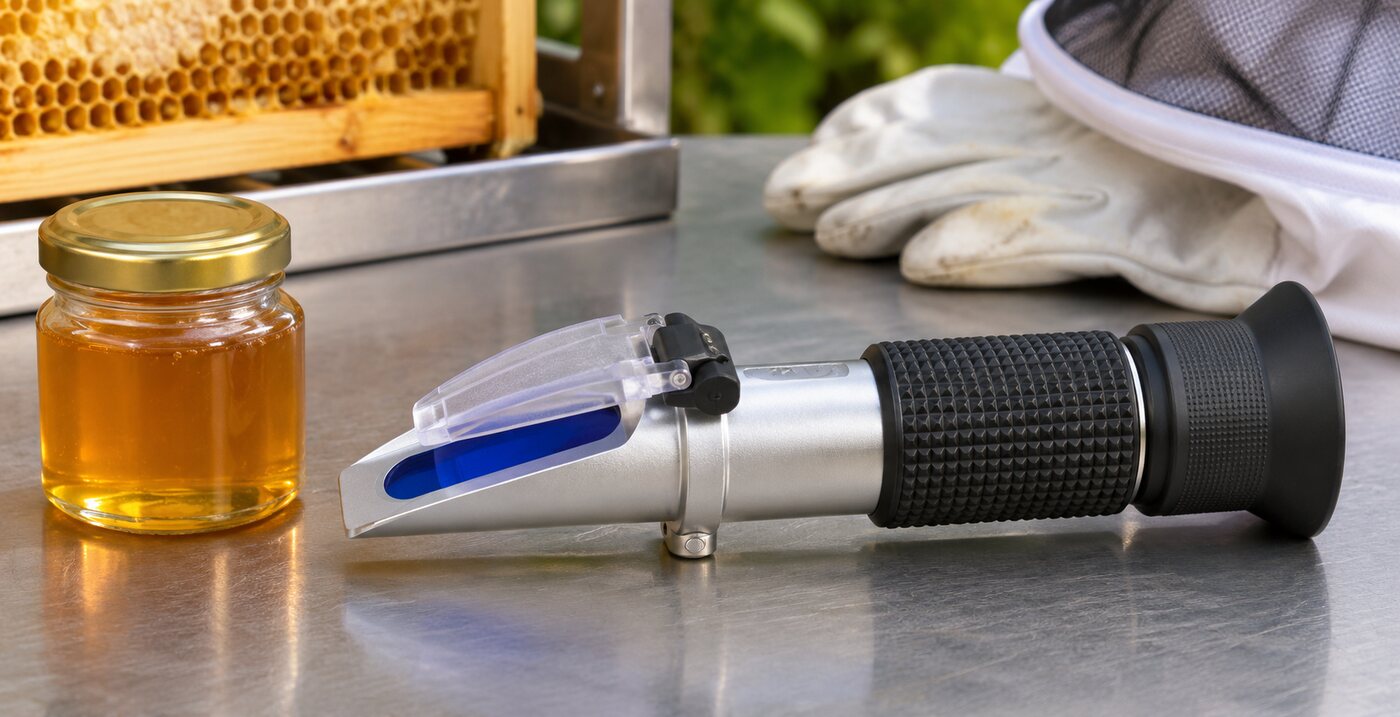
Look through an optical honey refractometer and you may see three columns of numbers sharing a single line. Which number should go in the harvest notebook? For a honey moisture reading, use the column labelled water, moisture or WATER %. A line crossing 18 on that scale means the sampled honey contains approximately 18 percent water by mass.
Find the right scale before you add honey
A refractometer measures how a sample bends light. The maker prints a scale that translates the optical reading into a useful quantity. Some honey models display moisture, Brix and Baumé side by side. These scales describe different things. Copying a Brix number into a moisture column, or subtracting it from 100 as a shortcut, can give a misleading result. If the instrument shows only Brix, use the manufacturer’s honey-specific conversion guidance or a meter designed to display honey moisture directly.
Check calibration with the reference material and procedure specified for your model. Distilled water may be outside a honey meter’s range. A clear-looking boundary tells you that you can read the scale. Calibration tells you whether to trust where that line falls.
Take a reading you can repeat
- Label the sample with its frame or batch. For a liquid batch, mix gently before sampling. For a harvest decision involving several frames, keep samples from different areas identifiable.
- Let the instrument and the sample reach similar temperatures within the meter’s working range. Start with a clean, dry prism and a fresh sample of liquid honey.
- Spread enough honey to cover the measuring surface and lower the cover gently. Look for gaps or trapped bubbles. Point the prism towards diffuse light, focus the eyepiece and follow the light-dark boundary across to the moisture scale.
- Record the unit with the number. Clean and dry the prism as the maker directs, then repeat with another drop. Keep the original readings if they disagree.
What a fuzzy line or a surprising number means
Try a fresh, evenly spread sample first. Check for crystals, leftover rinse water, a bubble or a temperature difference. A drop of clear liquid from a partly crystallized jar may differ from the jar as a whole. For work that requires a formal result, use a validated preparation method. The FSSAI honey analysis manual explains the laboratory method.
Suppose two samples from one frame read 17.6% and another frame reads 19.2%. Recheck the second frame separately before combining anything. Writing down which frame gave which reading preserves information an average would erase. The measurement describes the samples tested. It cannot, on its own, establish floral origin, purity or the condition of every frame in a super.