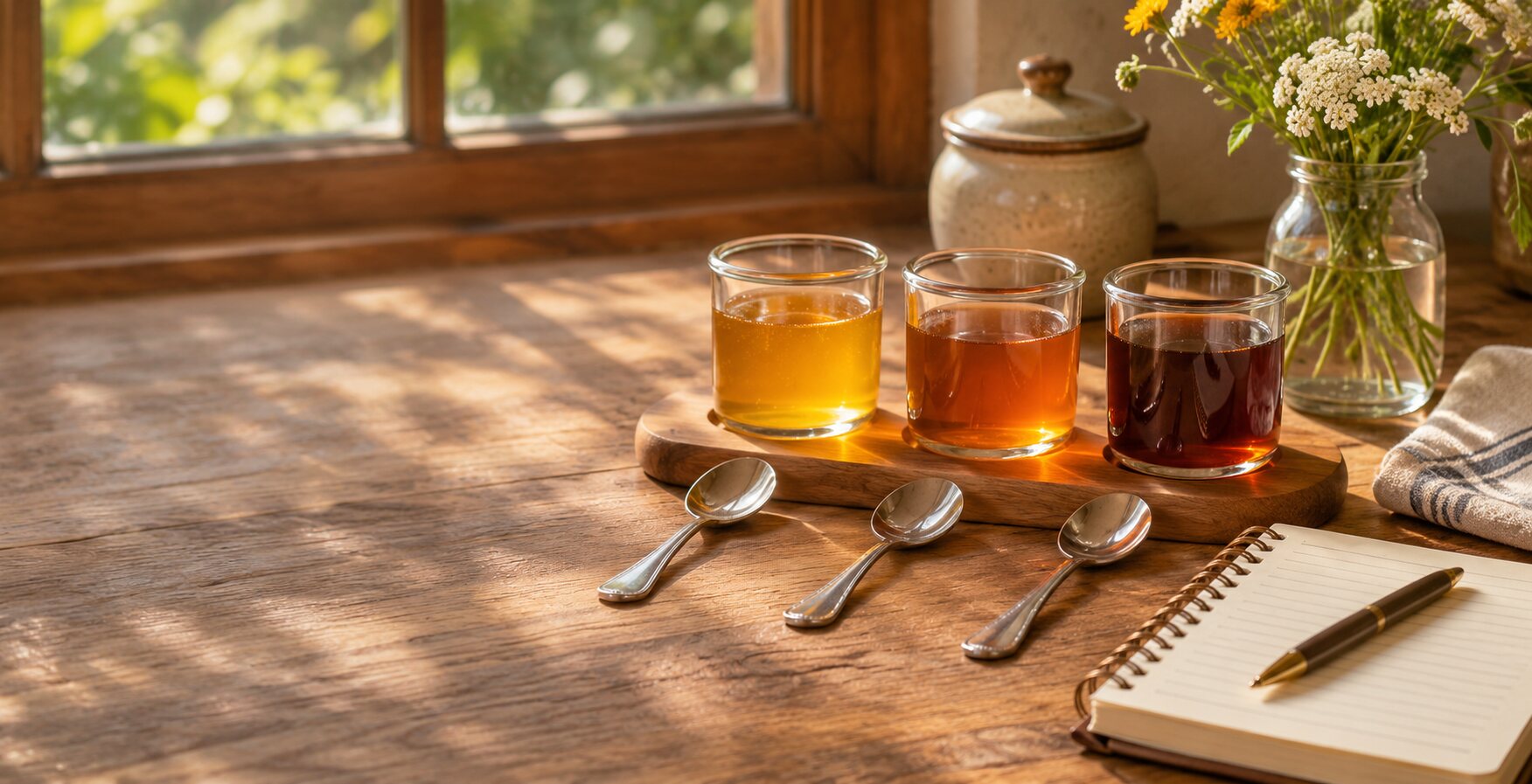
A spoonful straight from the jar tells you whether you like a honey. Put a second spoonful from a different jar beside it and you can usually say why. For a first honey tasting at home, set out three small samples at room temperature, smell each one before tasting, and write down what lingers after you swallow. You can do the whole thing at a kitchen table.
Choose three jars that answer one question
For a first flight, try a mild clover, an orange blossom and a buckwheat honey. The point is to give yourself three chances to notice a difference. Buy small jars or use what you already have. Three local wildflower honeys can make an even more interesting flight if the question is which harvest you want to buy again.
Keep the texture similar for the first round. A softly set honey alongside two liquid ones gives you two comparisons at once. Save that experiment for a second sitting, when you can ask whether you prefer a honey for its flavour or for the way it spreads.
Set the table before you look at the labels
Spoon a little of each honey into three identical cups. Mark the bottoms A, B and C, tuck the jars out of sight, and set out water and clean tasting spoons. A white plate behind the cups makes colour easier to see. If two people are tasting, give each their own spoons and write separately before comparing notes. The moment someone says “marmalade,” it becomes surprisingly hard to think of anything else.
Work through one spoonful in three passes
- Smell. Lift the cup and take a short sniff. Start with an everyday comparison. Does it remind you of a cut flower, newly opened raisins, toasted bread, or very little at all?
- Taste. Let a small amount spread across your tongue. Notice the texture first. Then breathe out gently through your nose and see whether another impression emerges.
- Wait. Set the spoon down. What can you still taste a few breaths later? Take a sip of water before the next cup. Revisit the first sample after the third.
A useful tasting note can be as plain as “faint smell, smooth, tastes like orange peel at the end.” If all you have is “sweet,” try an easier comparison. Which cup has the strongest smell? Which disappears first? Those answers are already enough to choose a jar.
A scorecard worth keeping
Write one line per cup with five entries: sample, first smell, texture, lingering flavour, where I’d use it. For example, “B | dried fruit | fluid | toasted finish | sharp cheese.” Leave the producer and harvest blank until you reveal the labels. Sensory notes record your impressions. Identifying a floral source or proving authenticity requires other evidence.
For the last round, put a little of each sample on the same plain yogurt or toast. Your favourite on a spoon may disappear in yogurt, while a honey you found too assertive on its own might suddenly be the one you finish. Circle the jar you would actually use and jot down the lot or harvest from its label. That last detail is especially useful when you return to a beekeeper who sells several seasonal harvests.
Try a blind second pour
Ask someone to pour a fourth cup from one of the same three jars and label it D. Keep the amount and temperature the same. Taste D between two known samples, then write which cup it resembles and the clue that helped you decide. A familiar aftertaste can be easier to recognize than the first impression of sweetness.
Uncover the jars only after writing your guess. If your two notes for the same honey differ, circle the words you used both times. Those are useful starting points for the next tasting. A note such as “fades quickly on toast, orange-peel finish on its own” is more useful at the shop than a score of eight out of ten.
Further reading
The California Master Beekeeper Program’s honey tasting guide describes formal visual and aroma evaluation. For a short introduction to retronasal aroma and the second taste, see UC Davis’s tasting tips.