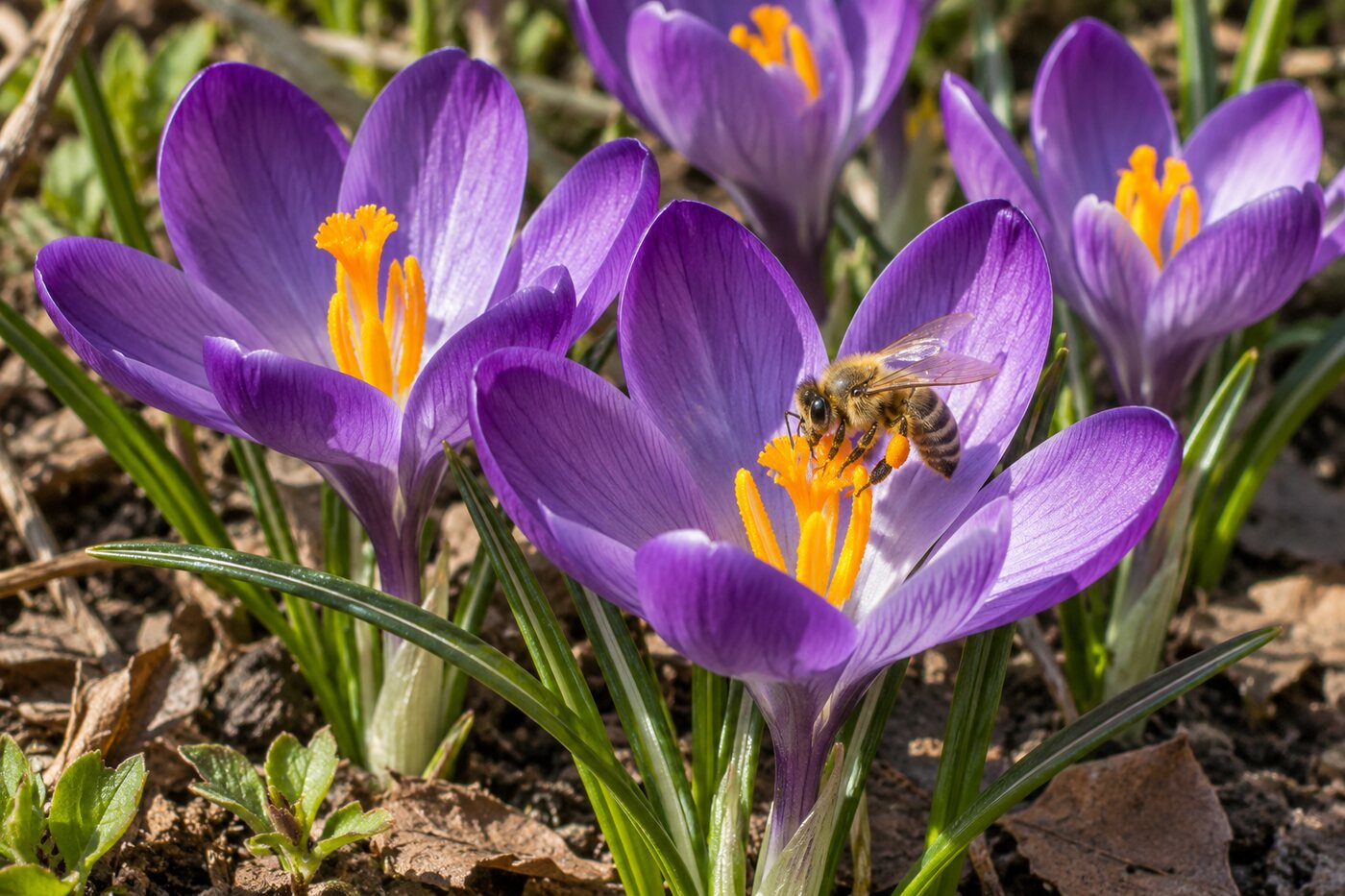
A sunny lawn edge that you can leave unmown for a few extra weeks makes a good home for spring crocuses. Their flowers offer pollen early in the season, when bees may have only a short stretch of mild weather to forage. Pick a spot where you can watch the centres of the flowers from a path. The busiest part of this garden can be only ankle-high.
Match the crocus to the spot
For sparse grass beneath a deciduous tree, consider woodland crocus, Crocus tommasinianus. The bare canopy lets light through during its flowering season. For a patch in an open lawn or a patio pot, look at spring-flowering Dutch crocus, Crocus vernus. Read the botanical name on the packet as well as the colour. Crocuses include autumn-flowering species, and those bloom too late for this particular job.
Before planting, look at the site after rain. Choose ground that drains freely, or use a container with drainage holes if the lawn stays soggy. A small group by a step gives you a much better view of visiting bees than a handful of flowers scattered across a large yard.
Plant in autumn and mark the mowing line
Plant dormant corms in autumn at the depth specified for the variety. Put a small marker at the outer edge of a lawn planting while you can still see where the corms went. In spring the petals disappear sooner than the grass-like leaves. Without a marker it’s surprisingly easy to mow the patch by habit.
Wait until the crocus leaves yellow before mowing over them. The green leaves are still gathering energy for the next flowering season. If your lawn needs regular early cutting, a border or container may be the easier choice. See the RHS crocus growing guide and NC State Extension’s woodland crocus profile for planting options.
When to watch for bees
Visit the same clump twice, first on a cool morning and again when sunlight reaches it. Note how many flowers are open each time before counting visitors. A quiet patch at breakfast can look very different a few hours later. Write down the first day you see a bee working an open bloom. Next spring, that local observation will tell you more about your garden than a flowering date printed for another region.