
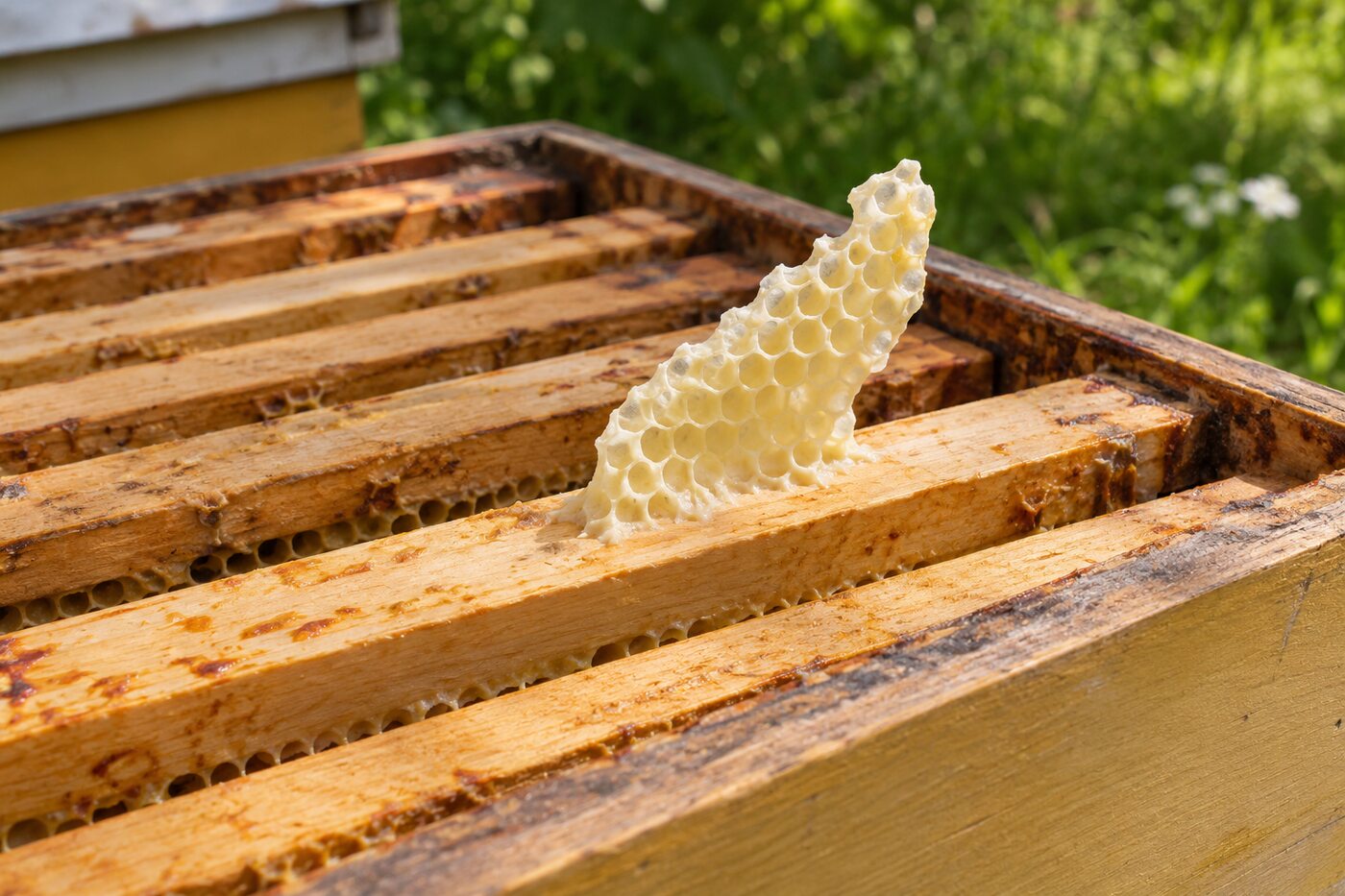
Lift the cover of a hive and you might find a little fin of white wax standing above a wooden frame. Look closer and you may see rows of cells in it. Beekeepers call this extra wax structure burr comb when bees build it outside the intended frame area. Its most useful clue is its location. A tongue of wax above one bar and a sheet between two widely separated frames point to different gaps in the equipment.
Why bees build comb in the gap
A movable-frame hive leaves narrow passages for workers. Beekeepers call that clearance bee space, usually about ¼ to ⅜ inch (6–10 mm). In a larger opening, the colony can have enough room to extend existing cells or build another piece of comb. The bees are using the space available to them. The difficulty for the beekeeper comes when that wax ties together two parts intended to lift apart.
For example, a frame left out of a box makes an opening roughly where another comb would naturally hang. A spacer left above the top bars creates a different opportunity. If the same patch reappears after an inspection, measure the clearance at that spot before assuming the colony simply needs another box.
Read the location before moving the frame
- Above the top bars. Look at the underside of the cover or the box above. A matching wax ridge shows where the parts met. Check that the cover, rim and boxes are seated as intended.
- Between neighbouring frames. Look down the row. Are the frames parallel? Is one gap noticeably wider? A comb drawn diagonally across several frames is often called cross-comb and makes independent frame movement difficult.
- Joining two boxes. Look at both surfaces as the boxes separate. Beekeepers often call the connection bridge comb. Record whether the cells contain honey, brood or neither before deciding what needs attention.
What to record at the next inspection
A useful note might read, “Wax joining the rear of frames four and five to the shallow rim above. Cells mostly empty. Recheck when rim comes off.” That gives you a location and a question to revisit. “Lots of wax” gives you little to compare next time.
Use care with joined parts. Pulling one frame abruptly can tear its neighbour or roll bees between them. If several brood combs are joined, an experienced local beekeeper can help you work through the arrangement without sacrificing occupied comb. For identification photographs, see The BeeMD guide to comb outside the frame.