
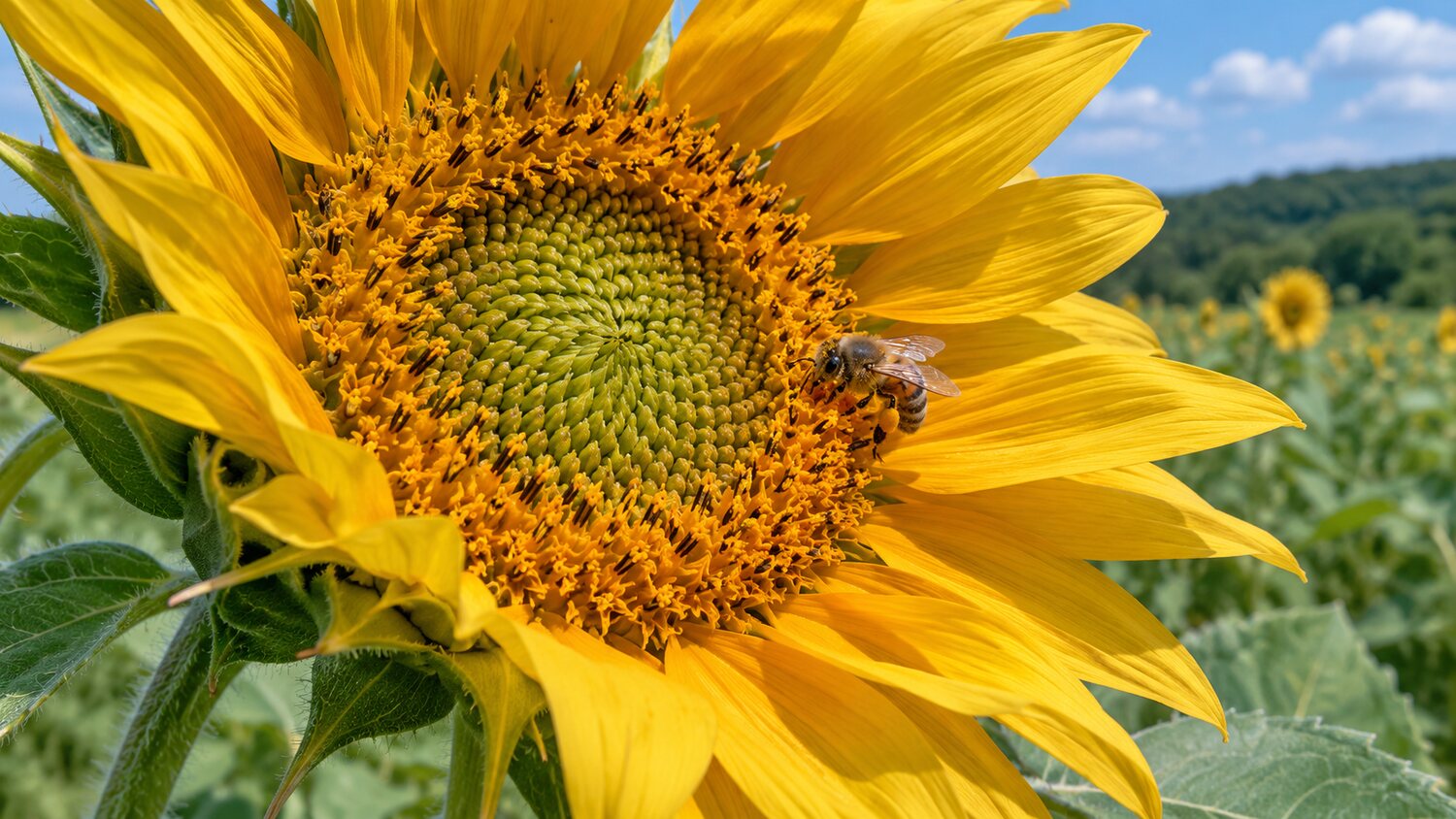
Watch a bee on a broad sunflower head and you may see it work its way around an arc, passing over the centre almost untouched. Look at the strip beneath its feet. The sunflower is a cluster of tiny flowers, and they open in successive rings. The bee can visit a dozen neighbours within a productive band without taking flight.
Find the tiny flowers inside the big one
Start at the edge. The long yellow rays give the head its familiar outline. The packed centre consists of disk florets, each a flower in its own right. Near the middle of a head that is still flowering, many florets may look like tightly fitted buds. A little farther out, a raised band can look dusted with gold.
At close range, compare three places along a line from rim to centre. The oldest florets are nearer the outside. The youngest sit nearer the middle. Between them are flowers at stages when they offer pollen or can receive it. Colour varies with the variety, so look for differences in height and shape as well as yellow dust.
Why the ring shifts inward
Florets in the same band can reach flowering together. In studies of common sunflower, a floret presented pollen first. On the following day its receptive stigma unfolded. Neighbouring rings were at different points in that sequence. The result is a flowering zone that moves inward over several days, even though the individual florets stay where they grew.
A visitor working along one band can reach a succession of florets at a similar stage. Other bees may take shorter paths or cross the disk altogether. The ring explains why an arc is a rewarding place to look. It does not mean that a bee must walk clockwise, finish a circle or collect only pollen on that trip.
Make a two-day sunflower portrait
Choose a head you can see comfortably from the path. Photograph it straight on with a distinctive ray near the top of the frame. Note where the freshest open florets sit relative to the centre. The next day, photograph the same head from the same angle and compare the two flowering bands.
For an extra observation, follow one bee for thirty seconds. Count the stops you can actually see, then note whether they fell mostly on a ring or across several bands. A visible pollen load adds information about the bee’s earlier foraging, but does not identify every flower it visited. Our guide to the pollen loads on bees’ legs explains what those bundles contain.
What happens to each floret after flowering?
A successfully fertilized disk floret can produce one of the individual fruits commonly called sunflower seeds. The spiral arrangement you see on a mature head maps the positions of those separate florets. If you grow sunflowers, keep a picture from flowering time. When the head matures, the familiar pattern of seeds makes a good companion to that earlier picture of a bee moving among flowers.
Research reference: UC Davis on the timing of sunflower florets and pollinator visits.